

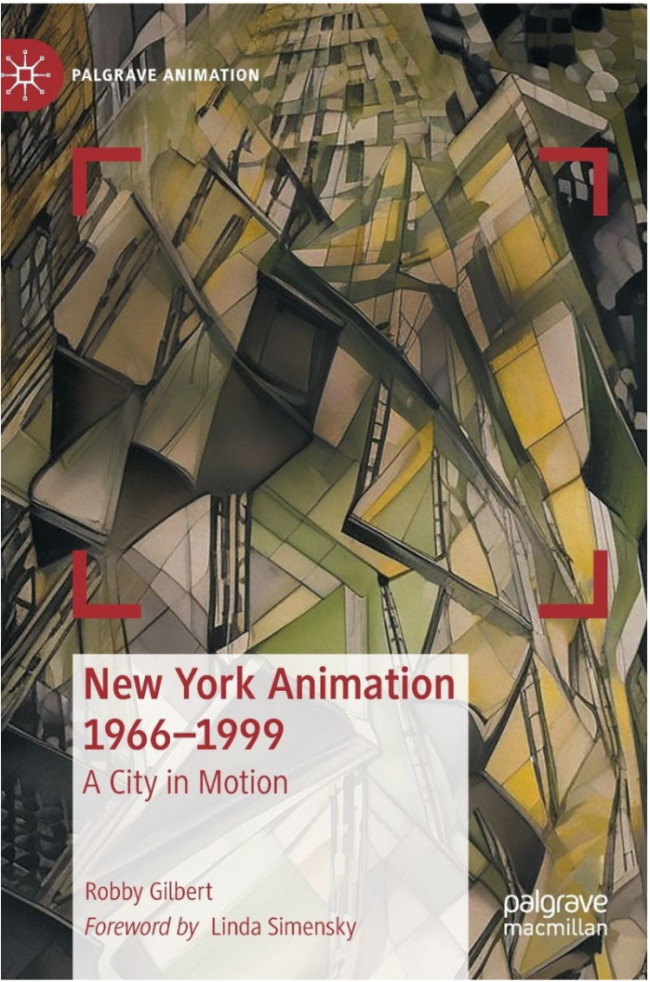
Interview with the author of New York Animation 1966–1999: A City in Motion
Interview with J.J. Sedelmaier

It’s hard to state the importance of Robby’s book to our community and, luckily, JJ sat down for coffee and animation talk to find out how it began and some of the inside stories that happened along the way.
JJ: Did you ever imagine doing a book?
Robby: I’ve done illustrations, children’s book illustrations and comic illustrations. But to do an academic book—it’s not something I ever set out to do before. And being a teacher was not something I’d ever considered doing —I was a terrible student—but now I’ve been teaching animation for thirty years!
JJ: Well, actually, just because you were a bad student that probably makes you a better teacher. I feel the same way. I was a terrible student. I think it had a lot to do with where you were educated.
Robby: Yeah, I think so.
JJ: But enjoying what you do and what you experienced comes through in the book as well. And speaking personally, I was so juiced to be a part of the whole thing because what you were doing was so, is so, important. And the time frame initially, my first reaction was, ‘what is it?’ And then within minutes it made complete sense. It was just an awesome period of time when everything was changing.
And, I’m glad you got to speak to as many people as you got to speak to. I mean, each and every day that goes by, we lose more and more people and the opportunity to reflect firsthand is just gone.
Robby: I wouldn’t have spoken to half of those people without you. Your fingerprints are all over this book.
JJ: Yeah, sorry about that.
JJ and Robby laugh.
Robby: I’m very grateful.
JJ: How did the whole thing come together, though? Did they [Palgrave Macmillan] approach you?
Robby: No. Not really. I’m a big fan of Eric Dyer. Do you know his work?
JJ: No.
Robby: He’s an animator. He did spend some time in New York.
JJ: He’s a Lower East Side guy?
Robby: He was, but he’s in Baltimore now. But he’s a guy who works with zoetropes and zoetropic art and is brilliant. And I’ve always been fascinated by his approach to extra-cinematic animation—taking moving images off screens and putting them into real space. He was doing a seminar in England and I was invited to speak at the event. Carolyn Ruddell and Paul Ward were there—they’re the editors of this series at Palgrave. So we all went out to dinner, and they were talking about ideas for books, and I said, “I’ve got some ideas”, and they said, “Great, send them to us.” So I pitched three ideas.
One was New York Animation. One was on zoetropic art. And one was the history of animation education. So they wanted the New York book. And I said, ‘okay!’
So my initial thought was—because my own animation industry experiences were just the 80s and the 90s in New York,—to write about Broadcast Arts. For all of its ups and downs, it was a wild place, and for a time the busiest animation studio in New York. And the story about that studio is amazing.
But then as I started to go down that path, I realized that, you know, I really couldn’t talk about the 80s unless I talked about the 70s and then the influence into the 90s. So it sort of grew into the last third of the twentieth century. And yeah, I think you’re right, it seemed to fill a gap that I didn’t realize was there until I started talking to people like you, Howard Beckerman, and John Canemaker.
I could see in John Canemaker face—and maybe I’m projecting—but when I interviewed him, (he was one of the first interviews), I felt like he suddenly realized that—this man, who had written so much history, and done so much—was realizing that now he was himself now an important piece of the history. And it was such an honor to talk with him.
JJ: And, it’s great, too, because I think the book will poke people into wanting to look into New York’s place in the industry. And look, I was guilty of it originally, too. I didn’t know animation had its start in New York. And, when you see how unique the industry has been because of being in New York, because of being around publishers and illustrators and cartoonists and art and just New York itself. It’s such a completely different industry than there has been any place else, but especially California. And all the people that are in California or that ended up in California, started in New York.
Robby: Yeah. As I write in the introduction, ‘The American animation industry begins in New York—full stop.’ And so many of my students don’t know that. I don’t think I realized that as an animator and as a student, because animation education is so often Hollywood-centric. It’s so fan based, frankly, and I think animation is such a diverse and wide and fascinating subject that to limit it to the Disney, the Hanna-Barbera—the cartoon paradigm—misses a lot of the opportunity of animation’s interdisciplinary origins and the entrepreneurial spirit that came out of New York. Edison, Kodak and then IBM and all these places. I didn’t realize it. You know, the first feature, animated computer film was attempted here in New York. There are many threads that needed to come together to bring us to the present, and many of these threads had origins in New York. Super 8 was introduced at the World’s Fair in New York and put single frame animation in the hands of children and independent filmmakers, creating a direct line between Super 8 techniques, Sesame Street, and then to Nickelodeon and MTV. I think there is a direct line which couldn’t have happened in Hollywood under that studio system that tended to exclude experimental styles, women, and artists of color. In New York, you had independent people —who were really working artists— experimenting with formats like Super 8, which came out in 1965, animating on the kitchen table.They could move clay around, use various materials and come up with techniques outside the cel-production paradigm. These techniques show up in the iconic MTV interstitials and changed the look of animation forever.
JJ: Yeah. It was really guerrilla filmmaking. And compared to the rest, it’s just like California was where you went after everything was worked out, proved and then it’s executed. And that’s why, for the most part, I think series work wasn’t a big thing in New York. It’s just these little boutique shops and advertising. The commercials that were produced for the industry, because you got to try all these different techniques and there wasn’t as much money riding on it and you could do wacked out stuff, and that was so important. And we’re losing that. Did you find when you were planning the book out that there’s so many different directions that you can’t not mention stuff because there’s so much relationship between all the things? That must have been a hell of a struggle.
Robby: It was a heavy lift. There are some heavy stories that couldn’t be put to page. I was taking care of my mother who had dementia when I started the research. I received the contract for the book the day after she died. It was during Covid, so we were stuck inside. And so I just put a large paper on the whole wall of a room and as ideas came out, just with crayons or whatever, I would write, for example, JJ Sedelmaier and then I’d scratch down MTV or whatever. I tried to connect the dots.. I still have it somewhere—it’s like a big mind map.
JJ: Sounds like a CSI episode.
Robby: Yeah. It was this huge, huge, wall of just scribbles and thoughts and ideas. And it
just started to come together. And then when you showed me the Oxtoby-Smith report…
JJ: Which came via Howard (Beckerman).
Robby: Yes. That report seemed like a good place to start because when you talk about the unions, they defined what the roles were contractually. And in an academic sphere and in an industry that doesn’t agree on what the very definition of animation is, to have something that says, all right, ‘this is what an animator is,’ ‘this is what an assistant animator is’, the Xerox operator, and so on. That struck me as a good place to start about New York because that report delineated the job titles and was analyzing the state of New York’s animation industry at a time of real downturn. It also defined the industry in a way that wasn’t just someone’s opinion. The union designations are what everyone adhered to. And it was pretty old school—it’s pretty division of labor. And so the Oxtoby Smith report and the unions were used to give a point of reference from which to start talking about the independents who deviated from these designations and really shaped New York’s trajectory.
JJ: And, and so much of what that report did was the antithesis of what New York animation is and the strength of it, because, once you’re classified as something, and you see this in California, you run the risk of only getting that opportunity. One of the things in New York that’s always been great is you might be animating one week, You might be designing another week, you might actually be producing and directing and all these opportunities at your fingertips potentially. So it was interesting in the 80s. I sat on both sides of the table. I started out sitting on the artists and animators side. And then when I became a producer at the Ink Tank, I was sitting on the producer side. And to see both sides of that, was very interesting, but New York has always been a reluctant participant in that whole process. And that I think that’s good because creatively you want to encourage your membership that anything is still possible that you can do something that was a real, real important moment in the 80s with a lot of us coming in. We were young, we were wide-eyed. We were naive. And the union shunned us for the most part. We’re just like the wine and cheese crowd, “Oh, these guys. You know, they didn’t shoot opticals. They weren’t here until three in the morning.” So that was unfortunate because it could have been a very interesting participation level on the part of the new group coming in that really never happened because they weren’t given the chance to be modern union members. It’s unfortunate.
Robby: But at the same time, you had this crossover period. You had old Terrytoons and Popeye animators like Johnny Gent over at NYIT with Alvy Ray Smith and Michael Sporn, and that’s an important thread that I never knew about. And I think it’s really important when we have this New York origin and this crossover period. And I got to work with people like Paul Sparagano—these old timer people—like Howard Beckerman. So there was still a little bit of that, you know. I could still smell that old school idea of what an animator was and what the process was and the timing and the exposure sheets. All that’s gone now. And then transitioning into interactive computer animation—stuff like that. So the more I looked into it, the more it’s just an amazing time for animation. And New York was central to this transition.
JJ: And there were those in those old timers who weren’t able to make that kind of move into modern technology. It was sad watching a lot of people who just couldn’t keep up, couldn’t stay involved and would have liked to have been there.
Talk a little bit about this whole struggle with how much the book costs.
Robby: Oh, thank you. Yeah. I didn’t know what they were going to charge for it. And it’s the first non-fiction book I’ve ever written. I never expected to write such a book. I went into it naively. I got a contract and I just signed it. I didn’t think about it because — maybe it’s going to sound self-serving—but I really wanted to just tell this story. I didn’t really care about the money or anything like that. I didn’t expect them to charge so much, though. I get no royalties out of it. I got six free copies, which I’ve given all away.
JJ: Thank you.
Robby: So it’s a little embarrassing because I’d love to be able to give everybody a copy that was involved, because I feel like that book wouldn’t exist without them. I had a different vision in my mind, much more Canemaker-like—something more broadly accessible. A lot of that is on me, though, because the Palgrave Animation series has a set format. ‘Artist me’ would’ve done a full-color coffee-table book!
JJ: Well, it’s definitely not a coffee table book but it’s still a wonderful, entry level, history to what New York is about. And I hope it also acts as a catalyst for more people to do the work.
How did you start the process of researching? Was it John Canemaker?
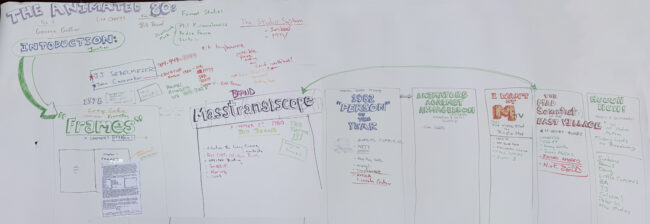
Robby: No. I started with that big mind map on my bedroom wall. I think you were among the first people I called. I talked to you before I actually called Canemaker. I remember calling you, leaving a message, and you called back pretty quickly, and you were really excited. And we had a great conversation about people to talk to and about— and that was a pivotal thing. And I’m very grateful for you.
JJ: Oh no, no, no, this is totally an honor.
Robby: And then as I talked to more people, there was excitement. I would describe the whole research process as’ all green lights.’ Everyone I talked to was so giving—like John Canemaker just gave me all these files on his computer. And then the same with George Griffin. He was the next one I interviewed. They just poured all these files in my direction. They were just so generous. You all were so generous. It was almost as if the project took on a life of its own.
JJ: Well it’s very exciting when you really feel someone is putting these puzzle pieces together. And we also are aware that we’re going to end up learning as much out of this as you are. And there’s that some of the connections you made and that the information you were coming up with was so exciting to hear. It just snowballed and it was wonderful.
Robby: Well, in our first conversation, I asked, I want to interview some Black animators for this. And you put me in touch with Dan Haskett. So I called Dan and he was most wonderful and said, “You’ve got to talk about Tee Collins, you’ve got to talk to Jim Simon.”
And these are some of the most extraordinary artifacts—and friendships— that came out of that to me. The Tee Collins’ story, finding Jim Simon, talking to Dan Haskett, understanding
that these people—Collins in particular being the first Sesame Street animator and the first Black animation studio owner—just how important that really was and could have only come out of New York, seeing that Sesame Street is Harlem based.
And, that was great. And then Yvette Kaplan, the first American woman to be credited as an animation director in a feature film. She didn’t even know that!
JJ: I didn’t know that.
Robby: Right? She didn’t even know that. And I wasn’t going to make that claim until it was researched. I talked to so many people and she turns out to be the first. A New Yorker!…on Beavis and Butthead Do America.
Those early days learning about the New York work of Pixar pioneers like Alvy Ray Smith, and the independent animators—the people like Lisa Crafts and Candy Kugel and Jane Dickson. The fact that women who were traditionally left out of the industry forged independent routes, which became Sesame Street, Nickelodeon, MTV, and Cartoon Network. In New York, people like Linda Simensky and Geraldine Laybourne and Betty Cohen changed animation forever. For a time, Nickelodeon even out-dollared Disney. And it was run by women! Why isn’t this common knowledge?
JJ: Gerry and Linda. Linda, oh, my God, Linda was just a godsend, is a godsend to the industry. She was so…
Robby: Terrific. And she’s New York based and very loyal to New York and so knowledgeable about it. It was such an honor to have her write the forward. I was going to ask you to write the foreword, and I’m sorry about that, but when I…
JJ: I would’ve just ended up talking about Linda.
Robby: …when I had the opportunity to get Linda on board…
JJ: Exactly. Yeah.
Robby: There was so much of the book that I felt like wasn’t my story to write. The Tee Collins business, the story of Black animators, the story of women animators. Every time I interviewed someone, I thought, someone needs to write a book on JJ, someone needs to write a book on John Canemaker…Linda Simensky and George Griffin, and Candy Kugel. But particularly with the Black animators. And it was Tee’s daughter, Dr. Barbara Collins, who convinced me that I had to write about her father..
JJ: Well, I think it’s terrific. And, I just think, like I said, it gets as much exposure and availability as can be. Hopefully.
Robby: I agree. If not, maybe I’ll end up doing another version of it which will be more coffee table like. I think that’s what I’d like to see. This book is just a starting point…there’s so much rich history to document about New York and animation and I hope others pick up the task.
JJ: There are definitely tasty visuals out there.
Robby: The tastiest!