
For the past couple of years our board has been really working hard to get the organization back to providing our members with the events and opportunities that we’ve had in the past. From restarting the aNYmator, to free figure drawing sessions, a renewed International Animation Day celebration, documenting our history online, connecting to our international network and not only continuing our festival, but improving it.
All of these things wouldn’t be possible without our newest board members and we think you should know a bit more about them.
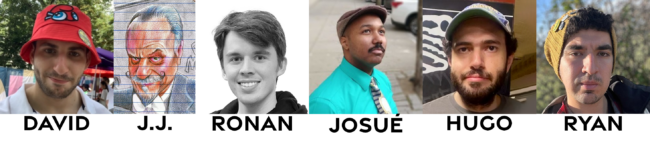
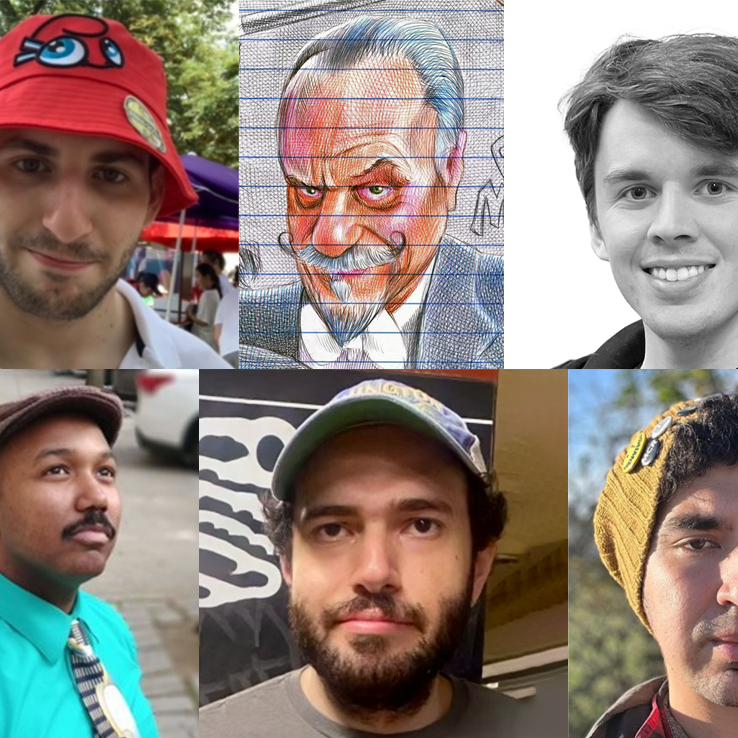
If you’ve seen our social media posts or have gone to a figure drawing session at Titmouse, Hornet or Buck, you can thank Ronan Madden. Soon our extraordinary history will be available on our website because we have Hugo Segal. Josué Advincola has been instrumental in organizing and running our live events. Ryan Castrillo has taken the responsibility of keeping us abreast and participating internationally. David Eisman is growing our film festival with many new initiatives. J.J. Sedelmaier has been helping us off the books on a variety of subjects for the past two years and, now as a board member, will be even more of an invaluable resource.
They all answered the same questions, via email. So, let’s say hello.
Give a brief recap of how you got into animation and your career so far.
Ronan: I have a mind that will stubbornly fixate on anything that catches its interest. The thing that just so happened to fixate me the most is animation. It’s why I graduated from Pratt Institute’s BFA in Digital Arts – 2D Animation back in 2023.
Ironically, my first break in animation was in a Children’s Book Illustration class. Professor Patricia Cummings shared that an animation studio was accepting interns. It was Bill Plympton’s studio, and I worked there during my junior year in college. Between that and my current position, as a Studio Assistant at Hornet, I did odd side jobs while balancing work as a barista in a neighborhood cafe.
Hugo: Although my ASIFA membership technically began in February 2020, the impetus of my involvement with the organization was during the final weeks of 2023. J.J. Sedelmaier, whom I consulted earlier that year for my student thesis, suggested I reach out to the president and inquire about future volunteer opportunities. By the start of 2024, I followed his advice and eventually secured a spot on ASIFA East’s board of directors.
Aside from my participation in New York’s animation community, I recently began a
three-month-long internship as a Gallery Assistant for Positive Exposure, which is a non-profit organization that provides a platform for artists with physical and developmental disabilities to express themselves.
Ryan: I got into animating in the beginning of 2022, with my first short and just made it a habit , with now 6 shorts under my belt. I’ve picked up a variety of freelance gigs ranging from helping smaller bands with brand and logo designs – to recently completing a video art edit of Marty Supreme for the magazine brand Heeb.
Josué: Ever since I was young, I have always been glued to the tv screen. Watching all sorts of animated content with my brothers lead me to foster my love for animation at a young age. As I got older and attended Hostos Community College my love for animation continued to grow. During my undergraduate years I began creating my own animated shorts. Thankfully I have also met pioneers and those currently shaping the commercial and animation space.
David: I started working in the animation industry during my first freshman year of college as a development intern at Frederator Studios in Burbank. I worked at Frederator for a little over two years – and while there, I met my mentor Steve Worth, who eventually invited me to join his organization, Animation Resources, a non-profit archive and foundation dedicated to preserving animation history. Initially, as a volunteer, I worked by scanning old artwork and cleaning up files in photoshop. Later on, when Steve asked me to join the Animation Resources board, I took on new responsibilities, like writing articles about animation theory for the bimonthly reference packs as well as helping to manage the media outreach. After five years in Los Angeles, I decided to move back to New York to pursue a career in special education. After returning, Steve asked me to reach out to ASIFA-East so as to connect the two organizations. I reached out, attended my first ASIFA-East board meeting, and quickly volunteered to help with the festival. This year, I am the Festival Chair for the ASIFA-East Animation Festival, working hard to put on a great 2026 season.
J.J.: Moved to NYC from UW/Madison in ‘79 to do comicbooks. Steered towards animation once I found out that there was a thriving NY Animation industry.
Met Tony Eastman in ‘80 and began assisting him as a freelancer.
Feb 1981 – First staff animation position (inbetweener) at Perpetual Motion Pictures working on Berenstain Bears/Strawberry Shortcake.
1982 – Assistant Animator @Perpetual Animation
1983 – On staff @Buzzco
May 1984 – Assistant Animator @ The Ink Tank
July 1984 – Animator @ The Ink Tank
Sept 1984 – Producer @ The Ink Tank
1986 – Executive Producer/Associate Director/Representative @ The Ink Tank
1990 – Patrice and J.J. open J.J. Sedelmaier Productions, Inc.
1990-2024 – Produced in-house film pitching “Cartoon Network” within Turner Broadcasting (1992)
Produced launch materials for Nickelodeon’s “NickToons” block, including interstitials, logo design and intro title/closing (1992)
Launched Beavis & Butt-Head for MTV, (1992-93)
Reintroduced “Schoolhouse Rock” (1993)
Co-Created “Saturday TV Funhouse” cartoons with Robert Smigel (1996-2001)
Co-Created “Captain Linger” series with Stuart Hill for Cartoon Network (1998-99)
Created/Produced pilot of “Harvey Birdman: Attorney @Law” for Cartoon Network/Adult Swim (2000)
Over 600 projects produced and 700 international awards garnered
(https://www.jjsedelmaier.com/)
Director, producer, artist/designer.caroonist, author, historian/archivist….
What responsibilities are you doing to keep our organization flourishing?
Ronan: I’m currently responsible for organizing Live Drawing Events that are hosted in animation studios across NYC, as well as managing our social media platform
Hugo: I have been scanning and uploading print issues of “The aNYmator” newsletter, which span from October 1990 to June 2007. I also scan and add print artifacts (e.g., event flyers, booklets, festival entry listings, etc.) to two databases created in the Internet Archive: one exclusively for ASIFA-East and one for Michael Sporn-related material. Each task connects back to the goal of physically preserving New York’s rich cartoon heritage.
Going forward, I plan on collaborating with like-minded animation historians whose breadth of knowledge will be essential towards unearthing new discoveries.
Ryan: I’ve been building bridges with a variety of organizations such as Japan Society and the mayor’s office of media and entertainment.
Josué: Currently I am a board member at ASIFA East. I have been assisting with the festival jury screening livestreams.
David: As the Festival Chair, it’s my responsibility to make sure the festival takes place and runs smoothly. That includes marketing, fielding the inbox, communicating with partner organizations, securing event spaces, managing operations for in-person screenings and awards shows, etc. This year’s festival is going to be particularly historic. We have entered a general partnership with Parsons School of Design: as such, the Awards Ceremony will be hosted at the Tishman Auditorium, The New School. Additionally, in collaboration with the New School WIA Student Collective, WIA NYC Chapter will once again be presenting the WIA Award, an honor which spotlights under-represented voices in animation. Last but not least, we have entered into an exclusive media partnership with Cartoon Brew, who in turn, will be presenting their own “Cartoon Brew Award for Excellence in Filmmaking” which comes with its own bespoke trophy.
J.J.: Helping to create and organize events that benefit membership and community. Actively arrange archival preservation of animation history related subjects and materials.
Are you working on any personal or professional projects? What’s been a career highlight to date.
Ronan: Currently I’m working (when I can) on realizing some passion projects. Focusing on a project can be a challenge in itself, especially when you’re working full time. But, when I can I produce an animated series of microshorts based on my experience working as a barista. It is a slice of lifestyle story centered around a shameless self-insert character. It’s very fun to work on. It can be viewed on my Instagram, @ramunderscoresart.
Hugo: The New York Animation History map project has so far been the standout highlight of my career, especially given that I tasked myself with synthesizing as much written material about the metropolitan area’s unsung impact on American animation to draw user engagement.
Ryan: Recently I just finished my two latest short films Lovers’ Quarrel (LQ) , and Family Obscura – and my career highlights would be my last short Dork playing in the festival circuit and snagging an award or two. Also recently just doing my first video DJ set and playing my animations in Brooklyn.
Josué: I am currently working on an animated series called “Work Buddies”. However, teaching and finishing my masters degree has taken much of my production.
David: I’m not currently working on any animation projects. However, I am currently trying to turn an old animated project into a book. I’ve only written a few chapters so far, but it’s been fun, and I like how it’s been turning out so far. In terms of career highlights, I would say that this year’s festival is soon to take that top spot. But beyond that, I would have to go with pitching a show my friend and I made to Frederator Studios. It almost got greenlit, but, obviously, did not. Still, it was a great experience and I learned a lot from the moment.
J.J.: Arranging animators’ archives. Setting up relationships with Syracuse University, Henry Ford Museum, and others.
What have you learned about our community since being a member? Anything you’re particularly proud of?
Ronan: Being a part of the ASIFA-East community has turned me on to the amount of talent that is around the NorthEast animation scene. I’m proud to be a member of a very well-connected, arts-centered organization
Hugo: I find that, in the two years since becoming an active member, our community has regained a certain degree of post-pandemic stability thanks to an open dialogue between seasoned veterans and the current rising generation of industry professionals. Despite being more of a “behind-the-scenes” kind of member due to my role, I have used ASIFA-sponsored events as opportunities to meet and network with people from all walks of life.
Ryan: I learned it’s such a small world. The amount of likeminded folks who also enjoy making weird stuff and talking about cartoons is awesome! And I think our new connections to now studios like BUCK and Hornet have been amazing too have!
Josué: I have gained extensive knowledge regarding the history of animation in New York and have encountered numerous individuals who have helped shape it. Speaking with many who worked on and produced the animated shows I watched in my youth is a surreal moment.
David: It’s been super interesting to just learn about the long history of ASIFA-East. The organization is decades old, with the festival starting up way back in 1969. It’s always fun to think about the different generations of board members who came before,
It’s been super interesting to just learn about the long history of ASIFA-East. The organization is decades old, with the festival starting up way back in 1969. It’s always fun to think about the different generations of board members who came before, the conversations they had, the problems they had to overcome. I am extremely proud to have the opportunity to work on a festival and within an organization that has so much history.
J.J.: The NY talent has always been a unique member of the animation community. Very fluid and versatile. ASIFA-East holds an important responsibility to educate, inspire and encourage its membership.
Do you have any ideas you have for the board to take on in future?
Ronan: I think that ASIFA-East, and ASIFA at large, should focus on supporting its younger members. It is important for those who want to pursue a career in animation to have a network of passionate people who can point them in the right direction.
Hugo: When it comes to planning future events, fo stering new partnerships with cultural venues and institutions outside of our Lower Manhattan bubble (e.g., the Northern Manhattan Arts Alliance, United Palace, etc.) will be essential towards spreading wider awareness of our organization.
Ryan: Honestly I’d love to see more anime related events but also maybe do a full ani-jam with our community- I’ve loved seeing different stuff like that across other organizations and festivals, maybe something for the community here, not just internationally.
Josué: I would love an ASIFA East animation mixer. This would allow animators of all levels to come together and mingle.
David: I’m already cooking up some new ideas for the 2027 festival, but I’ll save those for future board meetings. Beyond that, I would really like to catalyze some kind of deeper collaboration between ASIFA-East and Animation Resources.
J.J.: Assisting in the exploration of a permanent “Animation Archive/Museum”.
What kind of animation do you like/watch?
Ronan: I like very character driven pieces of animation. Animation is a medium that’s great at expressing emotion and depicting engaging characters on screen.
I’m also biased towards 2D hand-drawn animation. I can gawk all day at very well-rendered eye candy CGI, and I have to admit I immensely respect the craft that goes into it. However, I think an artist has more control over their work in hand-drawn cel animation. That is why I admire it more.
Hugo: I am usually open-minded with the types of animation I enjoy and appreciate, whether in short-form or feature-length. However, as I mature with age, I have come to accept that consuming animation on its merits of artistry and entertainment requires self-discipline, patience, and the ability to budget my options.
In terms of physical media (i.e., VHS, DVD, Blu-Ray, and 4K), I prefer renting from the New York Public Library system or purchasing through second-hand thrift shops and boutiques. Streaming content on services like Prime Video is a practice I exercise in moderation.
Ryan: I enjoy experimental animation, as well as stop motion, and anime as well. I love weird and trippy styles of animation. Lately I’ve watched the new Netflix short series Samuel, and Studio Orange’s Trigun Stargaze. Right now I’m excited for the IMAX release in March for Kiki’s Delivery Service.
Josué: I enjoy watching all sorts of animations. I really do enjoy independent animated shorts because they are more personal and experimental as well.
David: I grew up with cartoons like Adventure Time, Avatar: the Last Airbender, Regular Show, Batman Beyond, etc, so I watch those semi-regularly. I also watch a ton of anime – in particular, I like Cowboy Bebop, Samurai Champloo, Blood Blockade Battlefront, Made in Abyss, One Punch Man. I also watch a good amount of European animation, courtesy of Animation Resources bi-monthly reference packs: short films by auteurs like Bozetto and cartoons like Koziołek Matołek are featured regularly.
J.J.: I like to watch animation that’s been created for good instead of evil….