A conversation with Douglas Vitarelli
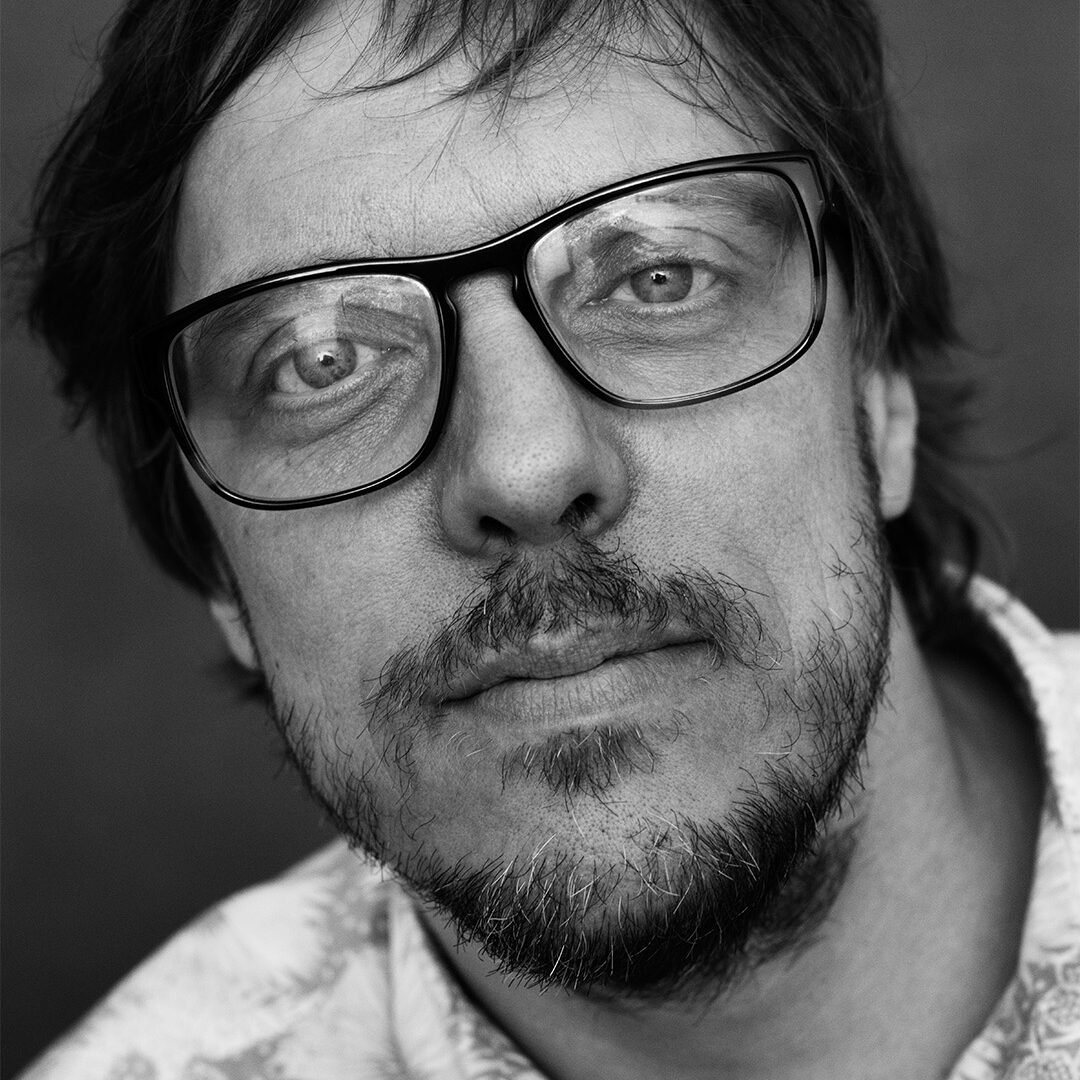
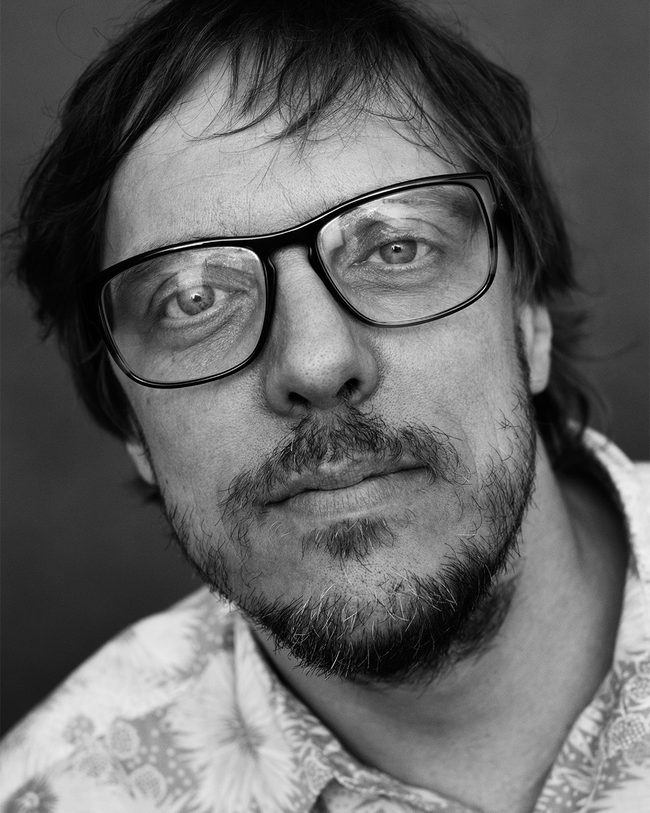
Dustin Grella is an animator whose work attempts to glean glimpses of colorful insight into the seemingly mundane. His films have screened at Cannes, Sundance, MoMA, and have been published in The New York Times Op-docs. His film “Prayers for Peace” screened at almost two hundred festivals worldwide and won over forty awards internationally. He has written and mailed himself a letter every day for the past twenty years and has over 7,000 sealed letters neatly filed and categorized. He is currently in production for the “Animation Hotline,” a series of micro-animations where he uses crowd-sourced voicemail messages for content.
Doug
So, can you tell us about yourself?
Dusty
I grew up in Medina, Ohio and moved to New York in ‘93. Then I moved to California for a while and then I moved back here to Ohio in 2007 for COVID and I just haven’t come back. I teach at Queen’s College and commute to teach some classes, and then I come back here.
Doug
Wait, wait, wait, you commute every week.
Dusty
It’s really not as hard as people think. It’s a direct flight, like an hour and 15 minutes. I got tenure about two or three years ago.
Doug
That’s fantastic!
Dusty
Thank you! I had no idea what I was getting into because when my studio was in the Bronx they asked me to do it to teach a class.
I never say no to an opportunity and when they asked: “Do you want to teach a second class?” I said sure. And then, once I started teaching, I got hired by Pratt and then I got hired by City College.
I was teaching a lot and then also running the studio. And then, Queens asked me to go full time, and I loved the administration and the staff and, then they asked me if I wanted to apply for tenure. I put in my application, and didn’t get the job.
My friends asked: “So are you gonna quit?” I said, “I don’t know, it’s a side job. The studio is full-time.” I liked it. Later they had another tenure track position open up, and asked if I wanted to apply? And I said, “Sure”, and just reprinted the application.
So I got tenure in 2024.
I didn’t really understand what the job was when I first got started, and now I feel like I’m pretty good at it.
Doug
Looking at your website, I was very impressed with the amount of work you’ve done. To start, talk about the success of “Prayers for Peace”, which, I believe, was your thesis at SVA.
How did that come about because you’re at SVA, a school with a great reputation and access to so many different technologies and equipment. How did you decide to do a very simple type of animation?
Dusty
I wanted to do animation all the time. I loved animation, as, I thought, every kid did. I didn’t go to an art school like Pratt or a SVA or one of these that have an animation program. I kind of made my own degree at the Myers School of Art in Akron, Ohio . I did interdisciplinary studies. It was in Humanities, English philosophy, some writing classes, anthropology, and some computer science. I didn’t get that heavy dose of the foundational art skills you get in an animation program?
And I was also kind of making it up as I was going along. It was in the era of Pixar’s Luxo Jr. and I think they had done Bug’s Life, and so everything was 3D.
So I was learning 3D, Maya, in school because that was what you did if you wanted to go into animation? And so you keyframe and then you hit render. And in those days, you went home, and you came back the next day to see how it turned out.
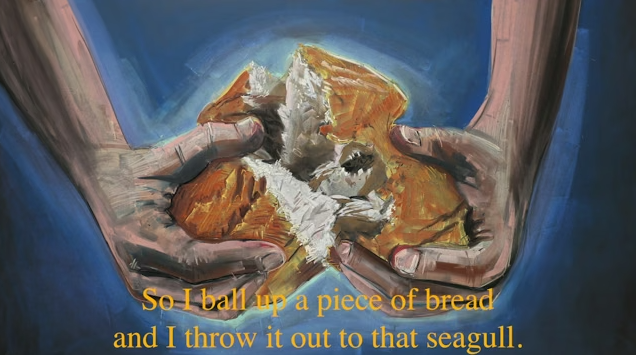
But what I really wanted to be was the renderer. I want to be the physical guy that gets in there and does that. So I was talking to my friend about this and he said there’s a camera that takes a photograph every every minute, every five minutes, every 30 minutes. It’s called an intervalometer and so I set up this camera. and then I did I think the first one. It was a 30 frame test.
I took it to the school and had my professor look at it. I didn’t understand how cameras worked and the exposure was just pitch black and (it was a digital camera) and he got in there, pulled the exposure up, so that we could see the grainy images of what I had drawn. It was just black and white and I loved it. I thought that was so much more fun physically to do it. I liked the organic, fluid animation. It was just an eye blinking, but it was enough to get me, you know, to get me excited.
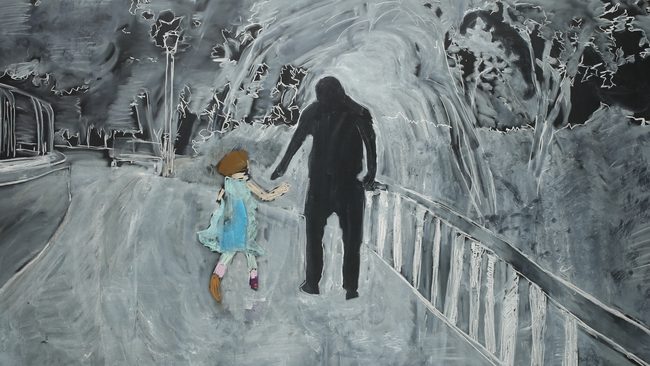
Eventually, I got like a big sheet of slate and pastels. I started learning about material and I like using the slate because it erases a lot better than a chalkboard.
And I got better with the camera. So, by the time I got to SVA, I’d already been doing this chalkboard 2D stop motion technique.
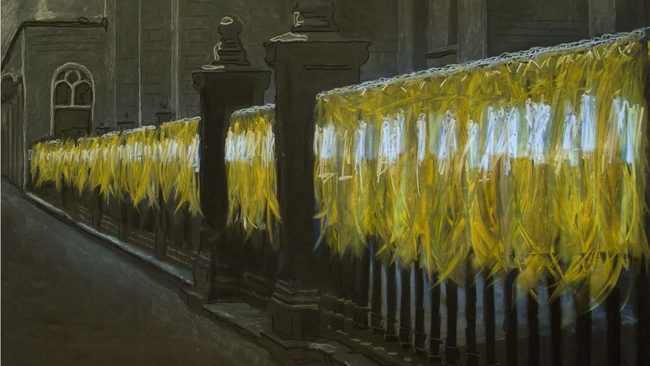
I had a story that I’d done in one of my other classes. It was formatted just like a story for the radio show This American Life.
I’ve already done the audio, so I used that as the jumping off point. The storyboarding took, I don’t know, like 6 minutes or something. It was just like, so obvious, it was like, boom, boom, boom, boom, boom. I knew exactly what it’s gonna look like
When I finished Prayers For Peace, one of my professors had me cat sit for four years at her studio.
Doug
Wait, she gave you an apartment for four years as long as you watch her cat?
Dusty
Yes, a Tribeca loft.
Doug
Wow.
Dusty
Yeah, the people were like, who did you have to kill?
Doug
No one likes you anymore,
Dusty
Right? I loved living downtown but then I moved to the Bronx, and I loved living there. A great space and super creative but harder to get people to visit.
That was where a lot of the work that you see on the website happened, like Animation Hotline.
Doug
Explain what the Animation Hotline is.
Dusty
Micro animations based on voicemail messages. They’re 20 to 40 seconds long. People would call and leave a message on my voicemail, and I would animate that voicemail. The idea was to do one a day and just kind of pop them out, like a comic strip, I was thinking this could be like Charles Schultz sitting down at his desk, and he does one comic every day and kind of moves on with this day.
And that was what my vision was, do it daily and have it be a conversation. Start having the same people calling, get some themes going on, like exciting love stories, and then have the arc of it and then the breakup at the end you have a whole story.
They were easy to digest and you could send them around but there was no money and I had to pay rent.
Doug
You did over 200 of them?
Dusty
Yes. So because I wasn’t able to get income solely from that, I started doing commercial work.
When I’m doing commercial work, I feel like it’s just as creative for me. I love working with the team. You’re getting feedback, trying to communicate a vision with someone, whether it’s your vision or theirs, trying to tell them what’s possible.
Dusty
Up to nine. It was usually two to three people. My brother was working with me for a while.
That was amazing because he’s an illustrator. Kind of kept the place up and running.
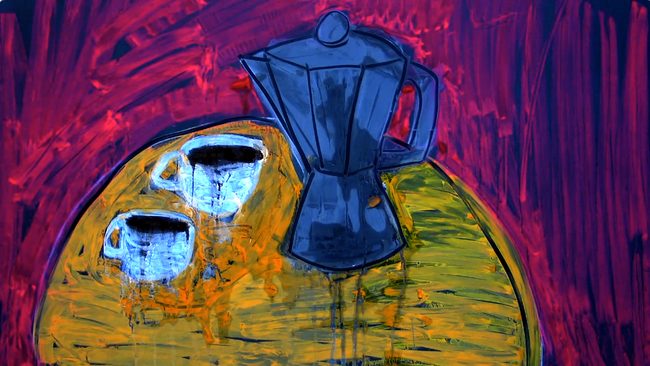
Every job was different, so we were always reinventing the wheel. Trying to figure out, like, how to navigate it and what it would look like. The chalkboard was pretty much the bread and butter.
Two chalkboards with workstations and the cameras were matching with all the computers. All the software was matching, so was the lighting so that you could draw on one and draw on another and have the two meet.
Doug
Cool.
Dusty
And it was really, really super fun. It was also exhausting. I would work an eight to ten hour day with them, and then they would go home and then I’d work an eight-hour day by myself to prep for the next day. I’d drive home and go to sleep in my clothes fully dressed on the top of the sheets and then I’d wake up, and I would go directly back. Sometimes I would sleep at the studio because it was just a lot of work. I loved doing it, so it didn’t feel wrong.
Then my brother and sister-in-law had moved to Brooklyn, which was really beautiful and brand new and great, but now that suddenly turned into a two-hour commute. Plus, I was teaching on a full-time tenure track, so I’m supposed to be doing a bunch of work for that.
Then COVID happened and it was a no-brainer to close the studio and go back to Ohio.
I set up a small chalkboard studio out here, it’s the same setup however it’s free! There’s tons of space, there’s no overhead whereas in the Bronx, I had to hustle every month for that overhead.
When I was younger, it was awesome, because at two o’clock in the afternoon when that silence went over the room and everyone was doing their thing, and it was just that feeling of being in that room with all creativity happening. It was palatable and that moment was what made it all worth it.
Doug
I want to talk about the bus first. How did the idea come about?
Dusty goes outside to give me a tour of the bus during the interview.
Dusty
I was a hippie when I was younger. I did Grateful Dead shows and all that, so I always wanted a bus.
It’s a medium length school bus. Seven windows and then it’s got the chalkboards on the sides. The idea was, I was gonna do an animation studio in a bus.
The studio was going to be inside and then people could go and watch the animation.
And then the idea stopped, because people aren’t really going to watch animation. It isn’t that exciting, somebody sitting there on a computer. It’s such a slow process so I decided to put the chalkboards on the outside. So that, um, it could be like more of an outside studio.
Doug
Tell me about your 2024 tour.
Dusty
I didn’t get very far on that one. Started in Ohio, then I went up to Vermont. Toyed around in New York a little bit and then down to Asheville, North Carolina and the exhaust system blew.
The conversation veers off to the local art scene, bus customization, the hurricane, ex-girlfriends and moonshine.
Doug
What is Midnight Moment, and how did it come about?
Dusty
So 12 artists a year get to play on the screens of Times Square. You’re playing on over 100 screens in Times Square, which is almost all of them and you get three minutes from 11: 57 to midnight, thus Midnight Moment.
Doug
How did you get picked?
Dusty
It was a submission through their website, I found out about it through a friend, and they they were “Oh Dusty, you gotta do this. This is your thing.”
Doug
What can we expect?
Dusty
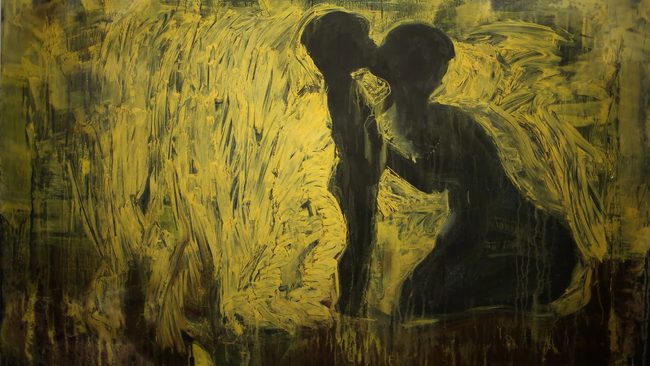
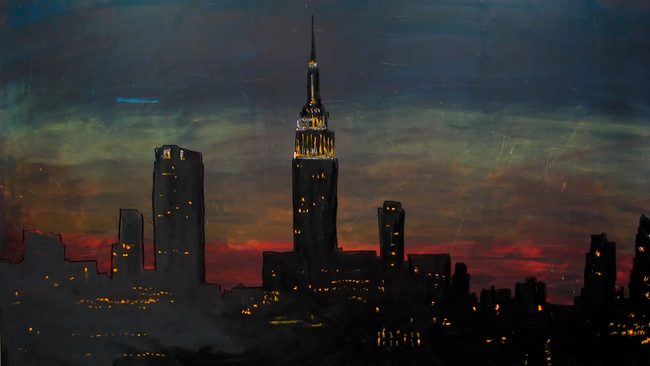
It’s very nostalgic, New York and love. There’s different types of love and it covers all of those.
There’s no sound, so it’s just a visual. It’s called Sunday Morning. You know, Sunday mornings are great in New York City.
Doug
Oh my gosh, they’re the best, right? I love them.
Dusty
So quiet and just maybe a newspaper. I don’t know if newspaper trucks still drive around the city, but that kind of thing. It’s like a light rain on the ground and the newspaper truck, you know, driving through an empty city.
Doug
It’s on the chalkboard?
Dusty
I think every shot is done on the chalkboard. It’s very simple, so I built a little app that you can download on your phone. It’s just one button right now and it downloads a song to your phone,.
So, there’s a page on the website and you click on the button and it downloads a song to your phone, okay. A timer that syncs up with the screens, and when the screens start, the song
Doug
Tell me about your 2024 tour.
Dusty
I didn’t get very far on that one. Started in Ohio, then I went up to Vermont. Toyed around in New York a little bit and then down to Asheville, North Carolina and the exhaust system blew.
The conversation veers off to the local art scene, bus customization, the hurricane, ex-girlfriends and moonshine.
Doug
What is Midnight Moment, and how did it come about?
Dusty
So 12 artists a year get to play on the screens of Times Square. You’re playing on over 100 screens in Times Square, which is almost all of them and you get three minutes from 11: 57 to midnight, thus Midnight Moment.
Doug
How did you get picked?
Dusty
It was a submission through their website, I found out about it through a friend, and they they were “Oh Dusty, you gotta do this. This is your thing.”
Doug
What can we expect?
Dusty
It’s very nostalgic, New York and love. There’s different types of love and it covers all of those.
There’s no sound, so it’s just a visual. It’s called Sunday Morning. You know, Sunday mornings are great in New York City.
Doug
Oh my gosh, they’re the best, right? I love them.
Dusty
So quiet and just maybe a newspaper. I don’t know if newspaper trucks still drive around the city, but that kind of thing. It’s like a light rain on the ground and the newspaper truck, you know, driving through an empty city.
Doug
It’s on the chalkboard?
Dusty
I think every shot is done on the chalkboard. It’s very simple, so I built a little app that you can download on your phone. It’s just one button right now and it downloads a song to your phone,.
So, there’s a page on the website and you click on the button and it downloads a song to your phone, okay. A timer that syncs up with the screens, and when the screens start, the song