
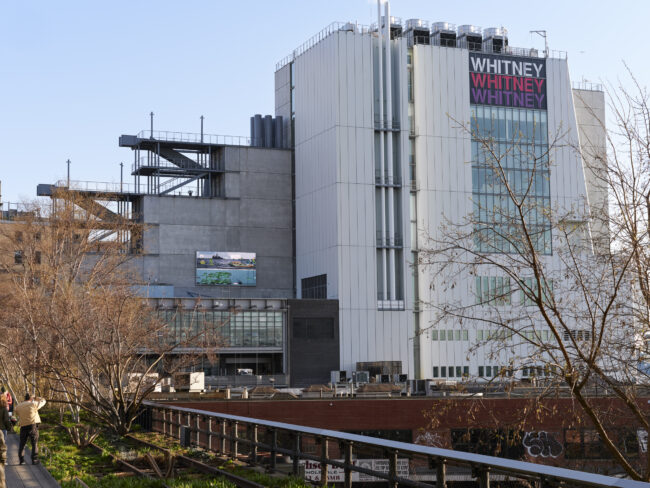
You never know what you’ll see when you go to Whitney for free on Friday night. The first was a model we hired for one of our figure drawing sessions at Hornet. The next was the animation of Marina Zurkow. She had 2 installations inside and one outside. Being charmed and intrigued by her work I wanted to know more and we had a fascinating discussion.
Interview by Douglas Vitarelli
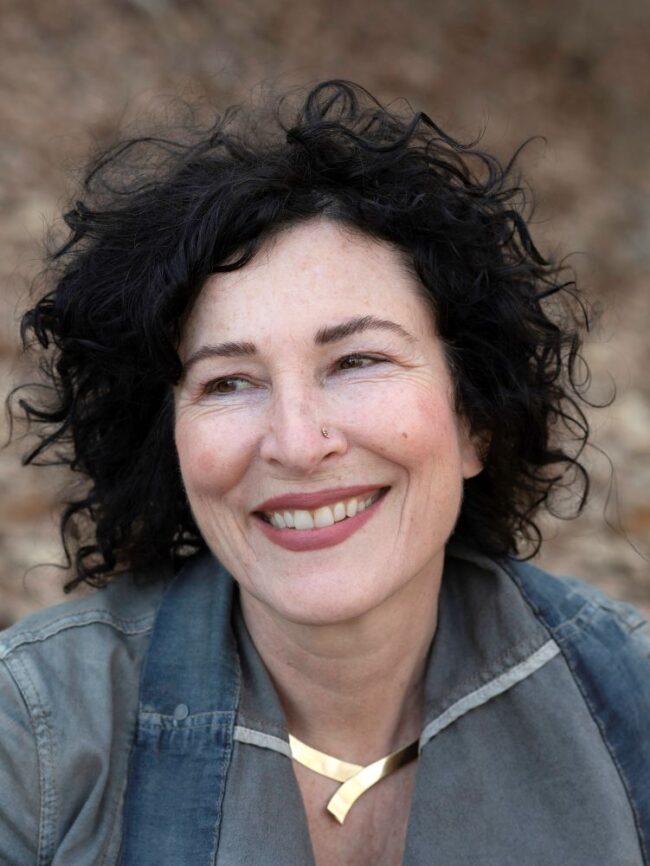
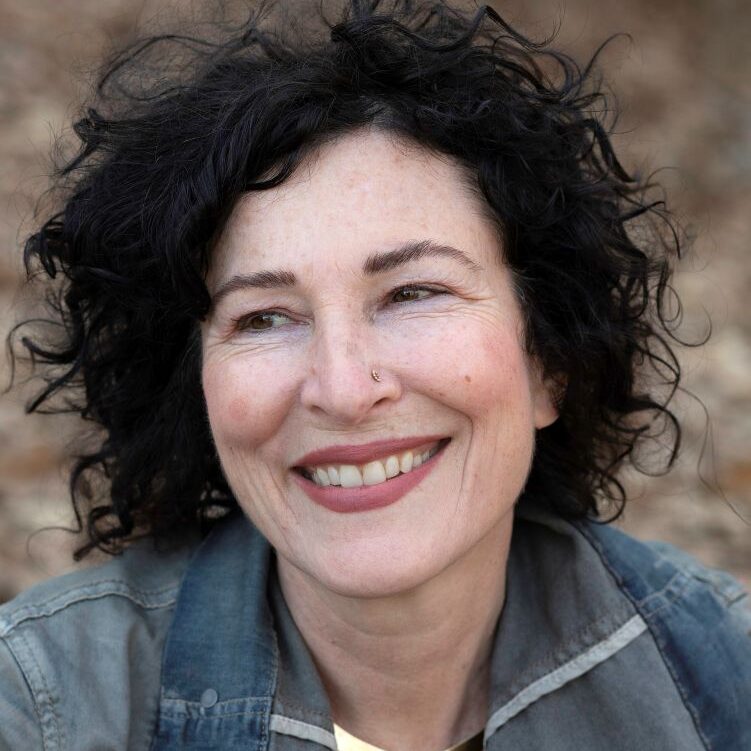
Media artist Marina: Zurkow invites people to explore ways of knowing and feeling nature-culture tensions and environmental messes. By engaging research, speculation, and technologies, she fosters intimate multispecies and geophysical connections. Zurkow works as a founding member of the collaborative initiatives More&More (Investing in Futures), Dear Climate, and Climoji.
Her most recent solo show Parting Worlds, including the Hyundai Terrace Commission at the Whitney Museum of American Art opened in April, 2025. Recent exhibitions include WHAT IF? at MoMA’s Creativity Lab (New York); Antroposcenes, Lo Pati Centre d’Art (Amposta); The Breath Eaters, Wolfsonian Museum (Miami); Underfoot/Overhead, Wasserman Projects (Detroit); and Can the Substrate Speak? Festival Art Souterrain (Montreal). Zurkow is a 2025-2026 grantee of the Science, Society & Culture division of the Simons Foundation, was a 2022 fellow at the Environmental Media Lab, Princeton University; and received grants from the John Simon Guggenheim Memorial Foundation, Rice University, NYFA, NYSCA, the Rockefeller Foundation, and Creative Capital. She resides in the Hudson Valley, New York, and teaches at NYU.
Douglas: It was so interesting to see animation at the Whitney, so I’m very happy to be speaking to you.
Marina: Did you see, oh my God, I’m blanking out his name. He had a really great show last year. Totally 60s, did all this light show stuff…He’s a god of that space.
Douglas: Harry Smith?
Marina: Yeah.
Douglas: I don’t see Harry Smith anymore, ‘cause I’ve seen Harry Smith, multiple times. It’s great and I love it and I was just reading (New York Animation 1966-1999, A City in Motion by Robby Gilbert) about him and I would like to revisit his work. He is a god in that space.
Marina: I just mean that it was at the Whitney, and it was a really awesome thing. They had quite a big show of his. Same curator as I worked with.
Douglas: Harry is kind of like you in a way, made for a museum setting. His pieces are very meditative, not the easiest to watch in a theater. Much easier to watch in the gallery space and/or museum. Especially with the setup that you had with the big red pillows.
Marina: Yeah, that was great. So my mother was a concert pianist who did a lot of Alexander Scriabin’s music, synesthesia. He wrote scores for lights in the late 1800s.
She worked with the Grateful Dead’s light show, Joshua lights.
Douglas: No one’s perfect. I’m making a joke because my wife is right next to me, and she’s a deadhead.
Nancy: Sorry, I’m eavesdropping, and I love that show.
Marina: Thank you! I appreciate it very much.
My mother was not a deadhead whatsoever. However, she wanted to realize Scriabin’s light scores, and so she worked with him, and they were working with the same kind of techniques: oil pan, rear projection, overhead projectors at Carnegie Hall.
Douglas: I saw on your Wikipedia page that you know all about semiotics.
Marina: Oh God, don’t trust Wikipedia.
When I went to art school in the mid 80s, you kind of had two choices. One was to go the post-modern route, and the other was to go the expressionist route. The expressionist route did not appeal to me at all. And so, me and my pretentious friends went the other way. And then I left the art world for a long time and worked in the movie business as a prop and an art director for non-union trash. But also music videos and record label art direction.
Douglas: Did you work in New York by any chance?
Marina: I did. I was city based. I had a little set building studio, and then I worked for Japanese television for a while. So, my experiences as a director/co-directed for music videos with my friend Abigail Simon. My space was sort of the Japanese pop culture universe for a good decade before I came back to making any art.
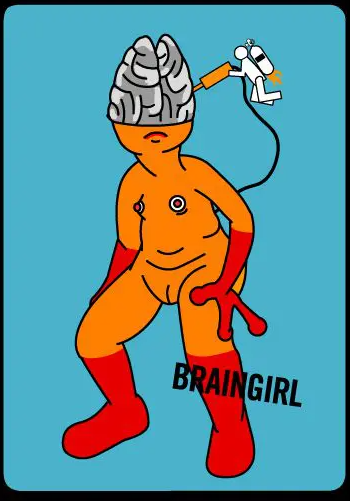
When I started animating in the 90s, I was told I was the worst animator in the world and I really was. If you look at my early work, I was terrible but I was a good weird internet based storyteller. I went to Sundance, Rotterdam, because the animation for the internet was literally five people. If you looked at “Braingirl” (my first project), it’s bad animation. But it is a good and surreal internet tale. And I’m still not a good animator because animators have never really embraced my work, so I’m thrilled to be here. Let me just say that.
Douglas: I’m happy to do it!
So, I think that most of us, when we decided to be an artist, dream of showing our work in a museum, but being animators, TV shows, movies, commercials, games are more of the platform. Tell us how you came to show your work at the Whitney.
Marina: It’s a winding story. Okay, so in 1994 I moved from making live action experimental small films on Super 8 and 16 to getting involved in the early internet and discovered Flash version 1. I realized that *all* I had to do was learn how to animate and I would be budget unconstrained and the world would be mine in a way that live action film never would allow me. Especially since I was really interested in magic realism and alternative forms of storytelling.
So here on the internet, I got a job at a company called SonicNet in 1994, it was the first music focused website that was funded. I lasted about a year and a quarter, and I couldn’t work for a company anymore; p.s. they went on to become MTV interactive.
I was in the whole dot com bubble. Working, partying. Being a New Yorker. Thrilled that nobody really knew what we were doing if they weren’t part of that scene. It was fun and at Sonic Net, we started making little animated music videos out of GIFs. That’s all you could put up there. So for me, constraints have always been the way that I have entered into animation.
I made a series called Braingirl. It took two and a half years to finish. It was a 10 episode series about a creature of the internet, a young prepubescent girl, naked with an exposed brain and her weird cast of friends, and she herself is a motherless child, like the internet in a sense was at that time and. Super experimental, serial, episodic. I went on and made a couple of other short pieces and then started animating with a focus on multi-channel artworks (for galleries, homes, public spaces). I was interested in making looping experiences, things that go on infinitely, and you could meditate upon them. They started to become more and more about animals and landscapes, for instance I used the structure of the Tibetan Wheel of Life to anchor a multi-channel story. By 2006, the work was thinking specifically about climate change and the environment at large and the animals became less metaphorical, and not stand-ins for humans. And what I wanted to do was use and kind of weaponize the purple candy world of animation. I wanted to enchant you with these seductive forms that invite you to suspend your disbelief and really go into whatever universe you’re in, in an animated world, in order to encounter difficult subjects like, what are we going to do after sea level rise? How are we going to live? How are we going to interact? How are we going to interweave ourselves with this planet?
So I’ve been doing this kind of contemplative animation work since 2006. At first I was doing linear works; the last one I made was in 2009, called “Slurb” (which is a mashup of “slum” and “suburb”). It’s an 18-minute linear animation with one assistant. It took me forever, and I was frankly kind of bored. I was making ambient landscapes or waters, and so I looked for a software developer. Veronique Brossier had been a Macromedia Flash developer and she worked with me to create a non-linear software base that I could throw characters onto the stage based on probability, and the thing would run forever and recombine. So that’s 2010. The first one was about Northumberland, England, about what it meant to be inside the garden versus outside the garden: Mesocosm, (Northumberland UK). I did a ton of research. I went to England. I interviewed a lot of people. I spent lot of time in the landscapes, and I thought about invasive species. I thought about characters like Lee Bowery as a gatekeeper to the garden. It was a complicated piece and really fun to make, and that was a breakthrough for me in thinking about ambience. Contemplative landscape studies that could unfold over time and be animated.
So that’s how I ended up in the Whitney. 15 years later.
Douglas: Can you just first start with the inspiration for the two pieces inside?
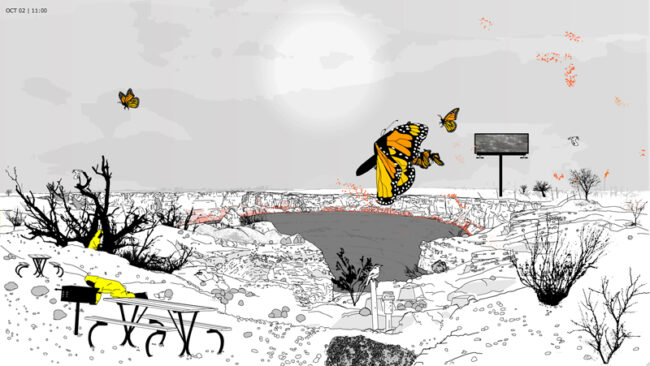
Marina: In 2011 I got the Guggenheim Fellowship and I pitched this idea to DiverseWorks, which is a non-profit space in Houston, to fund a research trip to West Texas to look at land-based oil production. The Permian Basin. Heart of the original oil boom in the US. DiverseWorks gave me $5,000 and I went on a two-week trip alone and interviewed a lot of different kinds of people: oil producers, ecologists, people against the massive oil industry, people against eminent domain, ranchers.
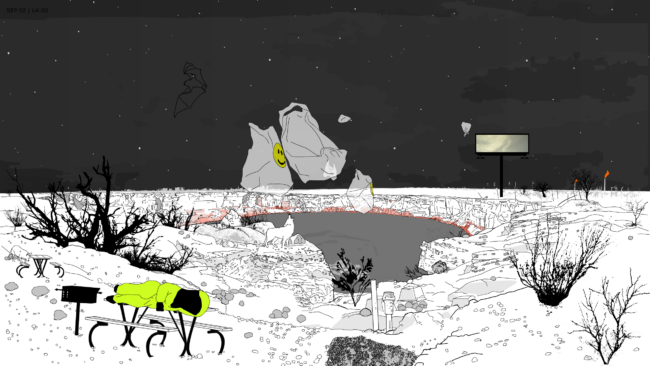
I visited and documented these subtle landscapes from Marfa to Midland, and all of this was motivated by something that happened before I left. I looked at the landscape on Google Earth and saw, just south of Midland, these two little pitch black holes in the landscape. Everything else is light brown with little white patches, which are the oil pads where the derricks go. So it’s just light brown and white patchwork and then there’s these pitch black inky black holes. They turned out to be two sinkholes that were on private oil company land that had collapsed, the land had collapsed from drilling.
It became, as is very typical for me, an obsessive mission to find out how I could go see them. They’re called Wink Sink 1 and 2. They’re in a town called Wink, Texas. 800 people live there. High cancer rates. Roy Orbison famously lived there. Otherwise, a blip on the map of what they call The Big Empty. A very derisive name. I mean, that part of Texas (the Llano Estacado) is really interesting and I learned so much about it.
And so what I was interested in was what really is there, and what’s this above and below differential? (Meaning, below is the Permian basin and the potential for more oil extraction and above being the “big empty” a landscape that doesn’t appear to be very productive in terms of human standards). And like, how are humans and culture and animals and environmental phenomena all interacting? So that is what Wink, Texas is: a mesocosm. A mid-sizes, experimental ecosystem. I did a series of these. The piece is titled Mesocosm (Wink, Texas).
You don’t want me to talk about tech?
Douglas: We’re animators, we talk about tech. You said before that you had someone who did the software for you and I’m really curious about that.
Marina: I’m going to offer a very cursory explanation of what James Schmitz does; he’s my full IP partner now because he’s a genius.
The thing about Wink is it’s a world that runs one minute to the hour. So, one minute of Wink time is one hour of our time, 24 minutes of Wink time is a day. So it takes about 146 hours to get through a full year of watching that piece.
From my perspective now, after doing this river piece, I have to say, this is a very simple piece. It’s only probability; a percentage of a chance that any character will come out at any given time and those percentages I handwrote using HTML code to say when any given character would come out (dawn, day, dusk, night, month, season). I should add that a character might be a butterfly, or wind, a hot air balloon, thick clouds, etc. These “buckets” of time tell the system which characters to come out. So the plastic bags that emerge out of Pandora’s sinkhole have only come out at night in certain months. And certain times a year the Monarch butterflies migrate through there. That is true. This Big Empty (the Llano Estacado) is not at all a big empty, but it’s a very subtle landscape.
So it was a small exercise in world building.
Douglas: And then there was the one next to it.
Marina: Yeah, “The Earth Eaters” is a totally different follow act. A total departure from all of the other works that I’ve done.
From the way the material was generated to the way that it was animated involved a lot of new skills I had to acquire to make that work. It started because I was looking at images and listening to the news about Gaza and Ukraine, and how ecological and environmental destruction is usually described as collateral damage. And I find that distressing, personally, distressing and I was thinking about the loop that’s created between mineral and rare earth extraction and the production of weapons of war. So, a huge percentage of where earth and mineral extraction goes to weapon support, to military defense all over the world. The number is unknown. I have a retired cousin from the Pentagon. Nobody can tell me percentages. Will not or cannot, but it’s a safe assumption that it is an enormous amount.
Think about this, this reinforcing feedback loop. You dig shit out of the ground. You turn it into weapons of war. You destroy things; you need more weapons of war. You dig more stuff out of the ground, so you get this, it’s not a happy story.
Douglas: And it definitely fits into your interest in loops from SonicNet.
Marina: I’m obsessed with loops.
So, let me just tell you about that piece, why it’s so dear to my heart.
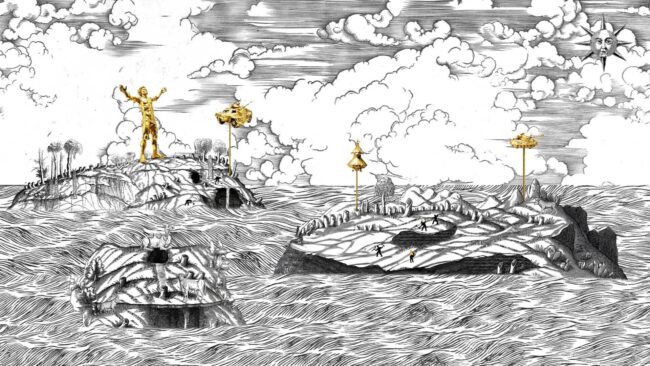
I trained some small LoRA’s (low resolution adaptation models) in open source AI and Stable Diffusion. I had to get a tutor to learn how to do this because I wanted to take these teeny little wood cuts that I found in the first book on mining by this minerologist, Georgius Agricola, who’s considered the father of modern mining. 1550 this book was published, called De Re Metallica and it was considered the official book if you wanted to become a miner in Europe.
The woodcuts are pointing out earth features that indicate that there might be valuable materials there. So I wanted to take these tiny woodcuts and turn them into Islands. This was an insane endeavor. I don’t draw like this, it would take forever. It’s ridiculous, so AI was a tremendous shortcut to evolve this material. I mean, the workflow for this project was off the hook because it wasn’t what people think of AI as I push a button, and I get an island. I had to train LoRA, get some features, then put them in another program with a control net of the shape of an island, then I get an approximation and take it into Photoshop to clean it up. So that alone was insane.
And then I had another suite of woodcuts from Conrad Gessner, who’s considered the father of modern zoology, who produced these gorgeous books “Historia Animalium”, also in 1550. This is the Scientific Revolution and these guys are paving the groundwork for modern technology and zoology, and so they were very important documents to work from, and I couldn’t just take one image and draw it. I wanted 150 of these. I wanted a menagerie. I had one baboon, so I would use AI to give me 12 baboons, and then I would bring all of those cleaned up assets into After Effects and puppet them so that they had some movement. And all of the weapons in the piece are, again: you train a small model on raw materials, iron ore, gold, diamonds, and then you feed it the shape of a missile or shape of an airplane, and it will give you an airplane made out of a diamond. That’s how I got my source material, which I then had to animate. same with the gold statues.
And then Jim (Schmitz), my collaborator, is such an important human being to my process, designed those geysers, and all the island dissolution. Which was also a tremendous feat, not to make it look like a computer. He took what would otherwise be an ugly, predictable computational eruption or subsidence and designed idiosyncrasy, staggering motion over time, grace and lurch. Computer modeling is not easy, as I’m sure you know, so it was a very large endeavor to make that work.
Douglas: Watching the first two pieces, I got all excited, like she’s really creating some really interesting animation that, as animators, we don’t necessarily see in a setting like this. But when I saw your outside piece, now, I was just kind of blown away because as I was watching it I was just turning in circles, seeing how you incorporated the environment into a site-specific animation, and that’s something I don’t know if I have ever said before.
Can you tell us how that piece came about? How did you get Hyundai to fund it?
Marina: Well, I didn’t get Hyundai to fund it. Hyundai gives the museum funding every year for that 5th floor terrace. The curator, Christiane Paul, the museum’s new media curator, put five names up, and they pick one. That’s how that went down.
Hyundai has an art hub called Artlab. It’s fantastic! The CEO of Hyundai loves art and they fund a lot of work around the world. So they wanted a new site-specific work in six or seven months. I suggested that I adapt and modify as much as possible this piece that I had made before called “Does the River Flow Both Ways?” That piece was already a minor adaptation of a Google commission, which was called “Hudson’s Follies” which still lives in the Google Pier 57.
What I retained from the original Hudson River works was all the fish ecology and then I redid the surface specifics to focus on the past. Present, and futures of the meatpacking District (the site of the Whitney Museum) and both the background and underwater scrolling panoramas.
Douglas: How did you get interested in animation?
Marina: It was originally my love of moving images and time-based media and secondarily, through the internet, through my work on the internet in 1994, so between those two drivers animation was, for me, at least in the early days, only a question of my own capacity. Other than the software tools, you didn’t have to pay for crews. You could literally work alone and create something.
Douglas: There’s a lot of New York animators who have a very similar ethos. They don’t like working with other people, and they’ve got a thing about creative control.
You said you’re interested in a different way of storytelling, as opposed to linear.
Marina: I am interested in slowness. You know, in a way, the museum’s not the greatest place for this work, the sweetest place for this work is in your home or in the street. If you’re waiting in a bus stop and every day you see the work, it’s different.That repeat encounter is the work at its best.
Douglas: Subways now have screens on them with movement, you should look into MTA because, like you said…
Marina: I did an MTA commission called “What is Happening?” with Sarah Rothberg. She and I did this piece for the Fulton Center, 55 screens, and then it showed in the subways for a while, maybe three years ago.
Douglas: Amazing. Thanks Marina!
Marina: Thank you! That was really fun to talk. I hope it wasn’t too rambling.