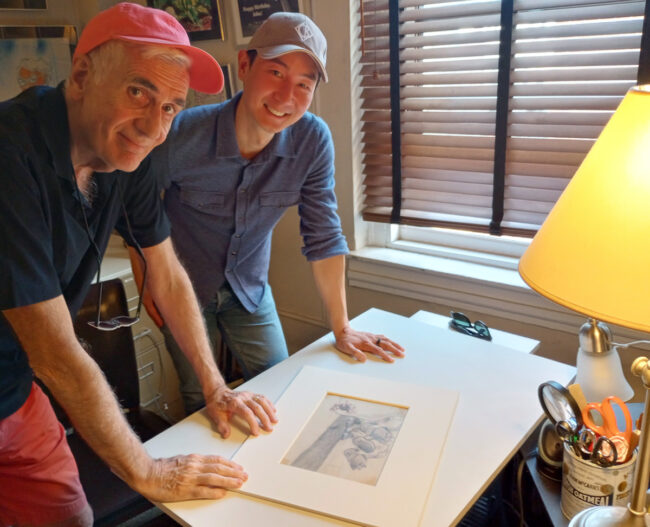
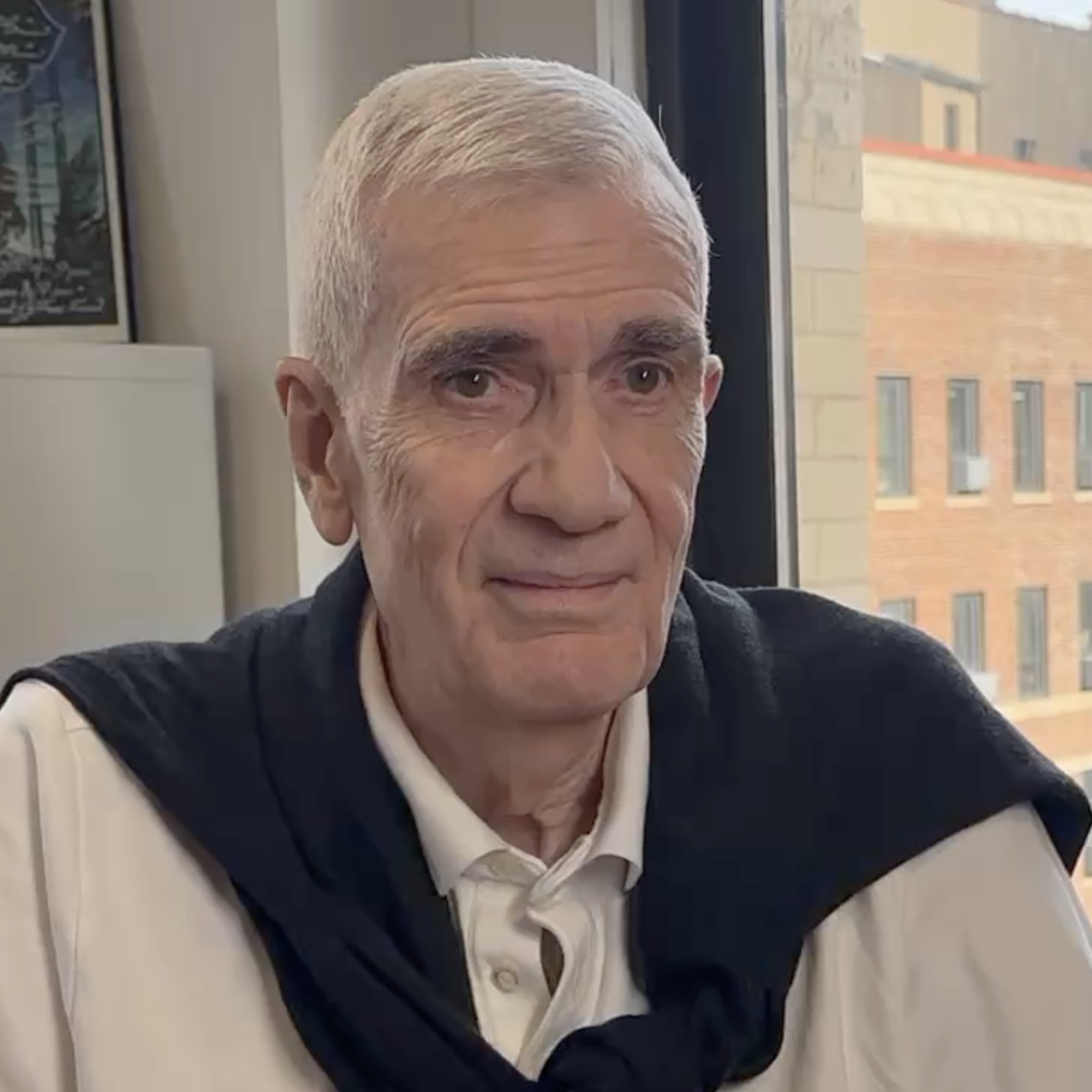
There are giants who walk amongst us here in the northeast animation community and it is my pleasure to share this interview with the irreplaceable John Canemaker with you..
-Douglas Vitarelli
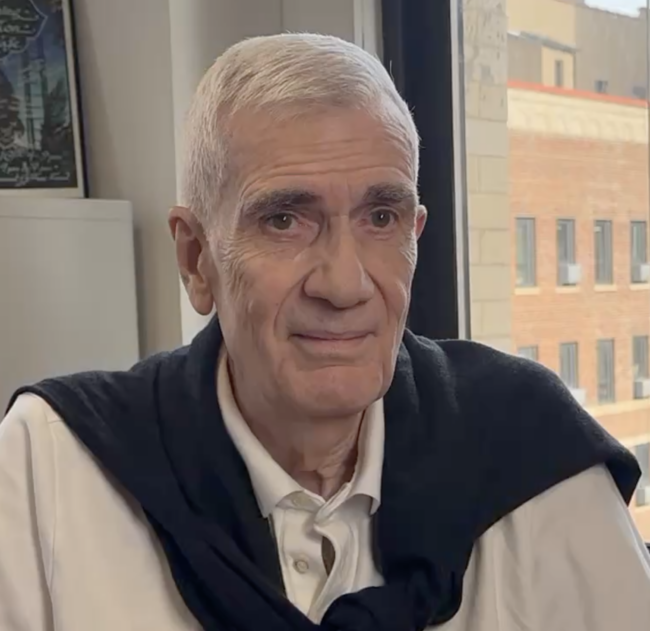
John Canemaker is an internationally-renowned animation historian and teacher. A key figure in American independent animation, Canemaker’s work has a distinctive personal style emphasizing emotion, personality and dynamic visual expression.
His film, The Moon and the Son: An Imagined Conversation, won an Oscar in 2005 for Best Animated Short, as well as an 2006 Emmy. He is a noted author who has written twelve books on animation, as well as over 100 essays, articles and monographs for The New York Times and The Wall Street Journal, among other publications. He began teaching at New York University’s Tisch School of the Art in 1980 and was one of the founders of the animation program. He became the program’s executive director in 1988 before retiring as a tenured professor in 2022.
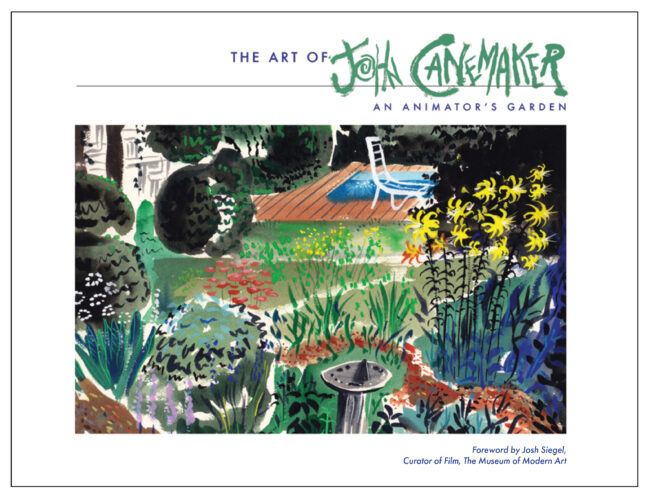
His most recent book is The Art of John Canemaker – An Animator’s Garden (The Old Mill Press, 2026). With full-color artwork, behind-the-scenes anecdotes, and reflections on nature, art, and the creative process, it is a celebration of a life in motion: resilience, curiosity, and the quiet wonder that blooms when we tend both to the soil and the spirit. <https://tinyurl.com/bdhfm662>
Douglas
Your book reflects back on your 50+ year career. Please tell us how it documents your life and career.
John
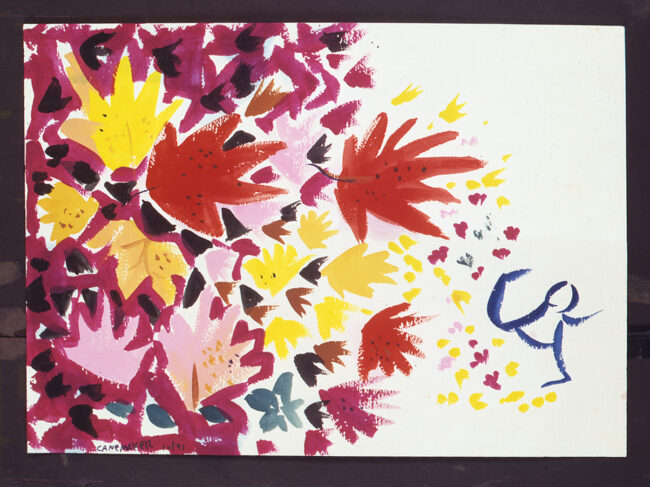
Well, my garden book, actually, is something that I’ve wanted to do for a long time. I’ve been drawing all my life. I’ve been painting for about 30 years. And in 1998 I made a personal film called Bridgehampton, based on paintings I made in that Long Island town. And so, it was a domino effect.
The writing of the book came out of my experience making the film. It is a showcase of gardening, preparing the soil for flowers and vegetables and stuff like that. It’s also about how I made an animated cartoon as well. So, it’s a lot of different things together, but basically the book stems from my love of drawing, painting and nature.
In 1988, When my husband Joe Kennedy and I bought a house in Bridgehampton, it changed my life because I originally came from a rural upstate New York, Elmira. I’ve lived in Manhattan since 1961, and so when we got the country house, it was like coming back to nature in a way. I started to paint, which I had previously done only for the concepts and backgrounds in my own films. I just enjoy the whole creative process. The book is 168 pages filled with my paintings of flowers, trees, birds, dogs, insects, all the seasons. The Old Mill Press publishers, Dave and Nancy Bossert, did a great job designing and producing a quality hard-cover book.
[John holds up the book]
Douglas
That’s gorgeous!
John
The book’s end section, goes into concept art and storyboards about the making of the short film Bridgehampton.
Douglas
I remember seeing Bridgehampton at the ASIFA-East Festival years ago.
John
The front of the book contains photos and material about my coming to Manhattan from Elmira and getting started in animation, but before that working as an actor in TV commercials, off-Broadway and in stock companies, being in the army…
Doug
You were in the Army? What rank?
John
I was a Spec 4, which is a specialist entertainment branch of the army. I was there from 1965 to ‘67, during the first big call-up for the Vietnam War. My job included preparing theatrical plays, designing sets and costumes, booking concerts for the soldiers starring Duke Ellington, The Dave Brubeck Quartet, The Sherelles, and organizing talent for outdoor bivouac shows.
I was extremely fortunate to serve at Fort Dix, New Jersey for two years. In fact, good luck has sort of followed me throughout my life, one thing leading to another.
Douglas
Can you talk about how luck has affected your career?
John
I feel that something we really love when we’re children, is something that will never leave you. And it’s something that could actually change your life. As I mentioned, I was always drawing as a kid, and I became interested in animation when I saw television shows that explained how it was created. There were two shows in the 1950s – the Woody Woodpecker Show, with “Uncle” Walter Lantz and Disneyland, with “Uncle” Walt Disney, who both often showed how they made animated films.
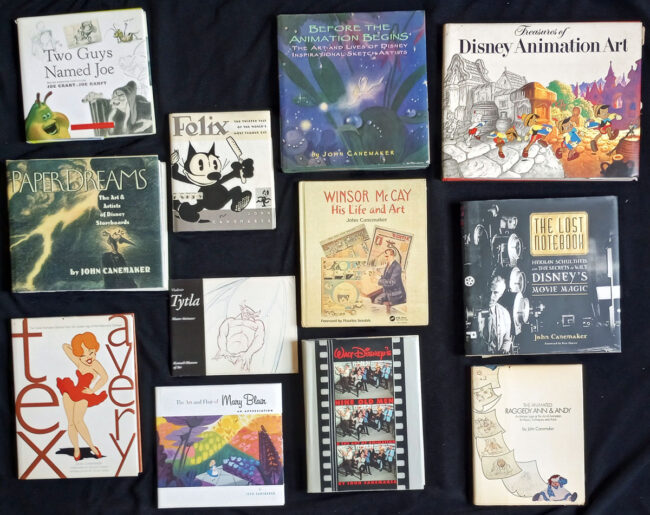
Disney’s show also offered programs on the history of animation. That’s the first time I heard about Winsor McCay. Disney also showcased his animators. His great “Nine Old Men” participated in some of the shows. So all of that came back to me years later when I wrote a biography of Winsor McCay and a book on the Nine Old Men. While in high school, I also made my own 16mm animated and live-action film. Ironically, it was about the history of animation, based on what I saw on a Disneyland TV episode. A direct steal.
At age 18, my family had no money to send me to college. I didn’t really know what I was going to do. In Elmira, I had appeared in amateur theatrics at the local college. I thought, well, I’ll come to New York and be an actor. I had $60 in my pocket.
I worked as a doorman at Radio City Music Hall for a year or so. Saw lots of movies there. Then I was a singing waiter in the Village, and these jobs supported me while I attended acting school at the American Academy Dramatic Arts. I also went to acting classes in the Village at the Herbert Berghof/Uta Hagen Studio, where one of my classmates was 16-year old Liza Minnelli.
Doug
She had an okay career.
John
She sure did.
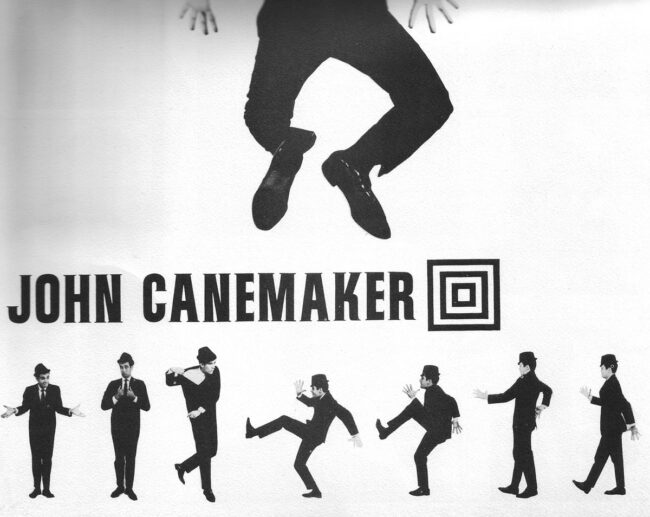
After the Army, I came back to New York and again appeared off-Broadway, in summer and winter stock companies, a WCBS-TV kids series, nightclubs, including the Rainbow Room with Sheila MacRae. I was Dick Van Dyke’s New York stunt double in two movies (“Never a Dull Moment” (1968) and “Some Kind of Nut” (1969). But mostly I appeared in nearly 30 national television commercials over three years. The commercials – for Armour Hot Dogs, Foster Grants Sunglasses, American Dairy Association, Esso Gasoline, Benson & Hedges cigarettes, among others – were lucrative. I saved my money. A friend said, “You’ve never been to college and you’re uneducated. Why don’t you use some of that money from your commercial residuals and go to college?” With the help of the GI Bill, at age 28, I attended Marymount Manhattan College for three years and got a BFA in Communication Arts.
And there was a teacher there, a dynamic nun named Sister Dymphna Leonard. She said, “You used to do this animation, didn’t you?” And I said, yes, I made a film when I was a kid, but I’m an actor now. She said, “I’ll give you six credits if you go to the Walt Disney Studio. They’ve opened an archive there. If you’ll learn about what Disney did with animation, I’ll give you six credits.” So, in the summer of 1973 I went to the Disney Archive, and archivist Dave Smith was very generous. I met eight of the Nine Old Men while I was there, saw many classic 35mm films privately, and examined, upclose, original animation art.
Interviews I did there with Frank Thomas, Ollie Johnston, Ward Kimball, and Marc Davis, I used twenty-eight years later when I wrote my Nine Old Men book. All of these things are just luck, happening one after the other. I wrote my paper for Sister Dymphna, got my credits, and she said, “Well, you’re going to graduate. Why don’t you go to NYU Graduate Film School?
I took her advice again and in 1976 I received an MFA in Film from NYU.
While at NYU, I made the documentaries “Remembering Windsor McCay”(1976) and “Otto Messmer and Felix the Cat” (1977). Simultaneously, I took an evening course in animation production at the School of Visual Arts. A short animation I made at SVA, I showed to various New York studios and became a journeyman animator working freelance with indie filmmakers Derek Lamb, Michael Sporn, Jerry Liberman, Bruce Cayard on Sesame Street, Electric Company and HBO spots. I was learning on the job, and made new friends and contacts through ASIFA-East.
I continued to make my own personal shorts, such as “Confessions of a Stardreamer” in 1978, which brought me press attention and eventually led to a contract to make an animation sequence in the Warner Bros. feature, “The World According to Garp” (1982). Then I formed my own studio and worked on HBO projects – the Oscar-winning doc “You Don’t Have to Die (1988), and in 1986 “John Lennon Sketchbook” produced by Yoko Ono, among many other projects.
At the same time, I was busy interviewing surviving pioneer animators, such as Winsor McCay’s assistant John Fitzsimmons, J.R. Bray, Otto (Felix the Cat) Messmer and Disney folk, writing and selling articles on them to film periodicals, eventually writing for the NY Times, Wall Street Journal, among others. I became Animation Editor at Millimeter magazine in the 1970s. Then CBS Camera Three asked me to host and write a show called “The Boys from Termite Terrace” (1977) I mean, it’s just unbelievable, one wonderful thing after another. I was a busy guy!
At Millimeter magazine, I wrote a piece on a new Dick Williams film being made in New York and LA: “Raggedy Ann & Andy,” which led to my first book contract. It all kind of snowballed. Sounds crazy, doesn’t it?
Doug
Sounds crazy and kind of amazing.
John
And then teaching came into the picture, too. A friend of mine, Richard Protovin, an independent animator, started the animation program at NYU. He hired me in 1980 to teach two courses. So, in addition to everything else, I started teaching at NYU. Richard sadly died a few years later of AIDS, and I was asked to take over full-timeI said, all right, I’ll try. Eventually I became a full professor. And then I started hiring people, including you.
Doug
You did hire me. And I was wondering (and there is a right answer for this one) who was your favorite adjunct instructor of all time at NYU?
John
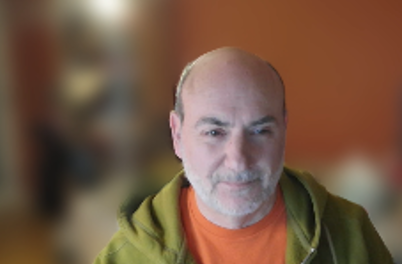
There’s an Italian guy who wears a green jacket, and he’s got an orange shirt that says Queens Bocce.
Doug
You’re very wise, man, John!
John
My legal name is Cannizzaro.
Doug
I know!
So I noticed that you paint in gouache and watercolor. As an artist, when do you decide what kind of paper to use, but really when do you choose to use gouache?
John
Sometimes I will do a background that needs to be soft in watercolor. And then when I need to do a solid flower or whatever, I will use the thicker gouache. In terms of paper, I’m now using 300 pound watercolor paper, Arches. It’s thicker. It can take a lot of water, and, sometimes you have to go over gouache colors, like yellow and white, so it’s a paper that can stand up to that. Recently, one of my former students, director Alex Woo – his film “In Your Dreams” is a Netflix feature – he put me in touch with Steve Pilcher, art director on “Brave” and Pixar films. He said, you’ve got to use acrylic gouache because it’s the colors stay.
Doug
Just curious, the Arches paper is hot press or cold pressed?
John
The one with texture. The cold pressed.

Doug
Since you talked about your former students, can you just name a bunch of them?
John
OK. Alex Woo;Jon Watts; Osgood Perkins; Brendan Bellomo; Michael Dougherty; Jonathan Annand; Sam Levine; Brad Schiff; Robert Marianetti; Sue Perrotto; Alexa Lim Haas; Eugene Salandra; Aiden Terry; Jennifer Oxley; Mulan Fu; Mo Willems, and many others. I taught at NYU for forty-two years and loved every minute of it.
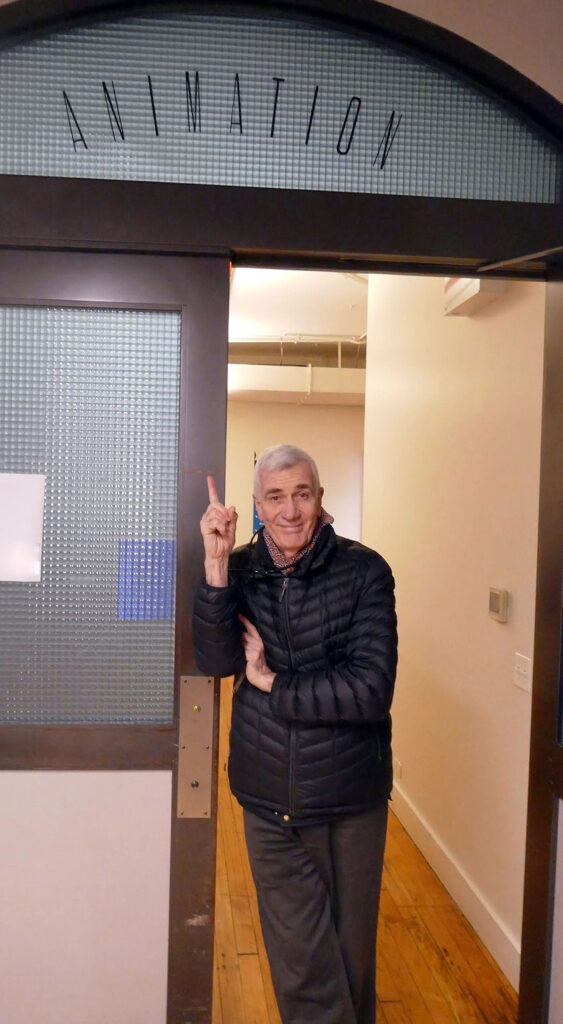
Doug
How did The Art of John Canemaker: An Animator’s Garden book come about?
John
More luck. For a while I’ve been posting my paintings on Social Media. Often I get messages asking, when are you going to do a book of your art? When are you gonna have a gallery opening? So about a year ago I was talking to Dave Bossert, who is the publisher of The Old Mill Press, and we made an agreement to create the Animator’s Garden book. Dave is married to Nancy Levey-Bossert, who is a gifted layout designer, and she’s done a spectacular job.
Doug
It looks very nice. You retired from teaching full time, but I believe you still teach a class.
John
I’m teaching my Action Analysis class on personality animation at NYU Tisch this spring.
Doug
It sounds like you’re still keeping busy.
John
I love what I do. Last year, the Walt Disney Family Museum invited me to lecture on Mary Blair’s designs. And I was a guest at the Cartoons Crossroads Columbus festival in Ohio. Netflix hires me each year to do on stage interviews of their animation feature directors, such as Guillermo del Toro for Pinocchio, and Alex Woo for In Your Dreams. This past weekend I introduced a program of digitally restored hand-drawn animated shorts from 1914 to 1998 at New York’s MoMA.
Doug
Well, we’re lucky to have gotten the chance to talk to you.