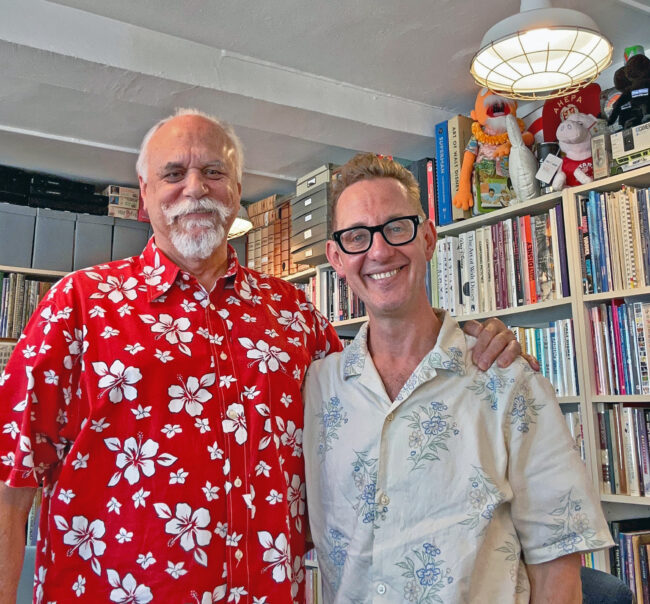

Interview with J.J. Sedelmaier

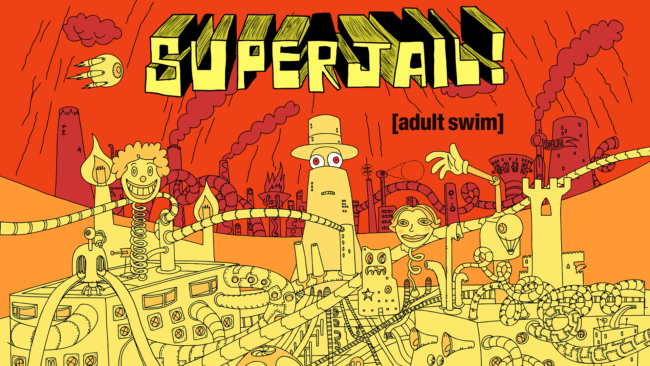
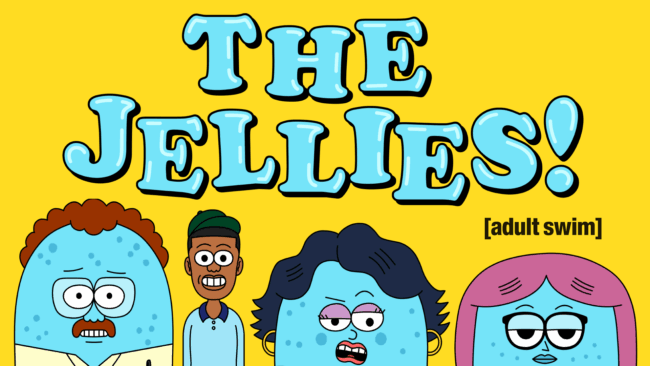
Aaron Augenblick is an animator, writer, director, and founder of Augenblick Studios in Brooklyn, NY. Since opening in 1999, his studio has been influential in popularizing the adult animation genre by producing shows like Ugly Americans, Superjail!, Wonder Showzen, and The Jellies. Alongside his commercial work, his award-winning independent short films have been featured at festivals around the world, including Golden Age, which was an official selection at Sundance. He is also the co-founder of the children’s entertainment company Future Brain Media, where he is the creator and executive producer of the popular PBS KIDS series City Island, which has produced 40 episodes, a spinoff series of music videos, and two video games. Aaron currently teaches art courses at Pratt Institute and the Brooklyn STEAM Center, sharing his expertise with the next generation of creators.
Why don’t you tell me about your background? Were your parents in the same kind of creative mold as you became? What got you inspired?
I grew up with a father who was a mechanical engineer at Hewlett-Packard and a mother who was an art teacher. I was big on Saturday-morning cartoons and devoured any comic book I could find. A lot of superhero stuff at first, then underground comics. All of that together made me want to be an animator very early on.
People ask me when I started drawing. I don’t remember a time when I wasn’t a cartoonist. I was always drawing cartoons. Even before I could write, I made comic books and told my mother what to write in the bubbles. So literally, at age one or two, I was making comic books.
My mother always tells the story that the first animated movie she took me to, probably a Disney film in the late ’70s, I was tracing the screen in the air with my finger.
And my father was always technologically obsessed. He taught me project management, spreadsheets, and how to use computers. Early on, I respected the integration of fine art and technology.
I’ve always loved making stuff and I’ve always been ambitious about it. When I was in high school, I started my own comic-book company. My dad and I would sneak into his office to photocopy the comics I was drawing. We made about ten issues that we used to sell at my local comic store on consignment.
And you were doing this all out of the Wilmington area?
In my bedroom in Wilmington, Delaware. Wilmington is sort of a cultural desert so luckily, we were near Philly. My dad’s from Philly, so we would go to the art museums and experience culture and the comic book stores that were always way cooler on South Street.
There wasn’t much of an arts program in my high school, so it was always just me alone in my bedroom, cooking up these crazy schemes. I made my own comic book company. I made my own animated series while I was still, I think, a junior in high school. Claymations with the family video camera, which I immediately loved. This was the late eighties.
And then because my dad, being who he was, would rig up our VHS machine so that I could add music to them. He would hook it up to our hi-fi system and I was overdubbing sound effects and music.
So I was doing all this animation. My dad was helping me and we were just figuring this stuff out on our own, like how to do overdubs and lip sync. So then my dad had bought me my own personal computer and there were very rudimentary animation programs on there. I think it had Autodesk software. So I graduated from doing these claymations to drawing them on the computer with a mouse.
I started making them and they were all kinds of genres. I would do an episode called Space Schmoo, where he would get launched into space, and I had Cowboy Schmoo. That was a Western. By the time I graduated high school, I had VHS tapes filled with animated shows and piles of comic books I had made, and then I went to SVA.
I still wasn’t sure whether I should be doing comics or animation, when they were looking at my comics saying, “Oh, these are cool.” I also brought this stack of VHS tapes and said “I also make cartoons.”
They said, “Look, if you want to be a comic artist, we are one of the most world-renowned comics curriculums in the world, but if you want to do animation, we have this kind of newish animation major here, and we think you have an aptitude for it. We’ll give you a significant scholarship. And I was, “Okay, well, that makes my decision right there.” It definitely made the decision for my parents.
So by the time I graduated SVA, I delivered my thesis on film, but I had done all my backgrounds in Photoshop. They were black and white and were styled to be like Fleischer.
Another important step was I made a sophomore film that got seen by Linda Simensky, she was the ASIFA-East president at the time and was at Nickelodeon. She said, “Hey, I really like this film. It’s really interesting.” It was also influenced by Fleischer and German Expressionism and she appreciated that. “Would you mind if I played this on Cartoon Network?” She had a show called A Night of Independent Cartoons on Cartoon Network, where she was playing her favorite festival stuff and a lot of it was from ASIFA-East. So, at age 19 or so, I was on TV.
And then I graduated, moved to Virginia and worked as a hotel night clerk because I didn’t know what to do with my life. I was working from 9 pm to 9 am and I had a sketchbook and would draw all night. And I got a call. Somebody tracked me down there from MTV, and, “Hey, we’ve been looking for you.” Someone talked to one of my roommates at SVA. “We saw your thesis film. We love it. And we’re doing a pilot based on the comic Hate by Peter Bagge and would you come work for us?” And I said, “Sure. When does it start?” And they said, “Monday.” And it was a Friday. So I moved out the next day. Drove back to New York City, crashed with my friends while I looked for a place, and went to work on Monday at MTV. And that was my first job.
The best thing for me at MTV was all the people I met.
And just the exposure to a work environment?
Absolutely. It’s also so good to meet people that are more talented than you because in Delaware, I was a big fish in a small pond.
But anyway, I got to be with all these people, and I met some of the most important people in my life there. I met Yvette Kaplan, Christy Karacas, Chris Prynoski, Tunde Adebimpe. Joy Kolitsky, who’s been a lifelong friend. So I made all these friends even though I was only at MTV for about two years. I didn’t last long there.
I started very entry level as a PA. but the pilot didn’t get picked up. Another great first lesson that just because you make something doesn’t mean it gets made. And then I got hired on the show, Daria. So that was the first real series that I worked on.
Because I’ve always been the indie guy I was like, what’s the quickest, most punk rock way that I can do everything right? So once you work in a corporation and you get into that Kafkaesque world, people don’t understand why they’re doing things, they’re like, “Oh, this is just the system that we use. You draw, just do the job. Stop questioning everything.” So in addition to that, I kept changing jobs. You know, first I was a PA then I was doing layout, then I went doing design, then I moved to storyboards. Then I ended up directing. So within a year and a half of starting at MTV, I was directing Daria. By that point I got to see the entire pipeline and understand how the designs work and x sheets and layout and the background department but yet was feeling very creatively unfulfilled. I kept pitching all these ideas, I was constantly pitching. I was so in love with the MTV interstitials and Liquid Television, they were such a big deal for me because for me, growing up in Delaware and not really having an access to sort of underground culture. And when I went to MTV, I was like, let’s do that stuff. And they’re like, no, no, no, we don’t do that anymore, we have this successful show called Beavis and Butt-Head. We want to do that more. So they were already moving towards bigger aspirations. And I wanted to be doing counterculture stuff. So everything I pitched died quick. So I just failed so miserably getting anything of my own off the ground that to me, I had no choice but to start my own studio.
But it sounds to me like you were destined to have your own place because you have a point of view. You have a drive. And is that when you decided this is it?
I believe it was ‘99, and I made this decision. I think I had just finished the season of Daria that I was working on, and I made this decision to start a studio. I don’t come from money. I’ve never had a lot of money, and I didn’t have a wife or kids or even a girlfriend, and I just put all my money that I made at MTV in the bank, and it just sat there. By the time I was done at Daria, I maybe had like ten or twenty grand in savings. And that’s what I used to open a studio.
You opened it in Brooklyn?
I pulled a couple friends at MTV that were all equally “Let’s try something wild” and we looked around and found the cheapest possible rent was in Brooklyn. Younger people will not realize that Brooklyn was not always the coolest place to be.
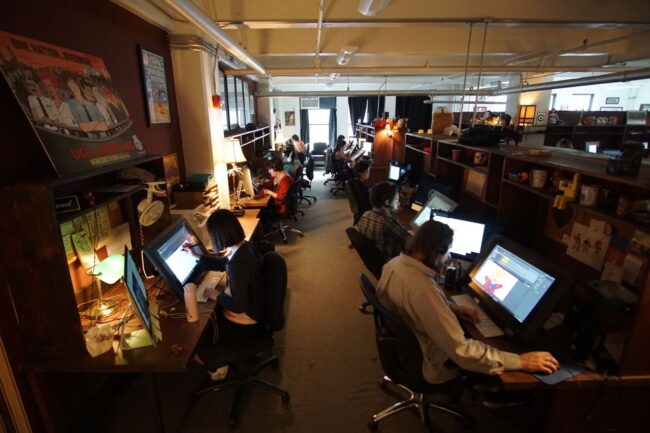
We found the cheapest possible rent in this place called Dumbo and it had just started becoming gentrified by the Walentas company. They had bought up all of the old warehouses because nothing was happening there. They were looking for artists, like they always do when they’re beginning to gentrify a neighborhood. And they gave us incredibly cheap rent. It was literally just a few hundred dollars a month to get a nice sized space in an old warehouse.
I was still finishing up at MTV and my bosses heard a rumor that I was going to start a studio and I got called into their office. I go in and there’s a bunch of producers there. They said, we heard a rumor that you’re going to be starting your own studio, and we just want to tell you that 99% of studios fail within the first year. And you can go do this, but you will most likely fail. And if you want to return, you are not necessarily going to have a job here anymore. So just know that this could possibly be the end of your career.
In other words, when we heard this, we got so fucking scared that we’re going to try to discourage you.
I honestly don’t think they were scared of me. I think they genuinely were annoyed. I think that they liked that I was good at my job and they thought I was genuinely making a mistake.
So I went home and I was terrified. I was like, Oh my God, I’m twenty two years old and my career is already over. What have I done? What am I going to do? And I thought about it and thought about it. And you know, it’s true. I think you said something earlier that when you’re young, you’re reckless because you have nothing to lose. I had nothing to lose. I had no accomplishments. I had nothing in my own name. And my thought at the time was, I’m going to go do this thing. If I fail, I’ll do something else. I always love comics. Maybe I’ll go do comics. Maybe I’ll do something else. The Super 8 hotel in Virginia probably would rehire me. I was good at that too. So I was kind of just like, okay, well, if this doesn’t work out, I’ll just do something different in my life. So I did it.
So the postscript to the story that I think is important, and what makes it a pivotal moment, is that I started the studio. I struggled more than anything I’d ever done. I had no idea what I was doing. I couldn’t find work. It was terrifying. But I made it through the first year. And a year later, MTV closed. Not me. They closed. There’s a beautiful golden age in New York City where there were all these incredible studios, from Curious Pictures to Ink Tank to MTV animation, and they were all hiring and they were all doing really cool shows. And I never in a million years would have thought that that world would go away.
But there I was, and now I had my own studio and we were already working. I thought I was starting a studio to make feature films, to be honest with you, I had this concept. I had written a feature script while I was at MTV, and it was still the 90’s. And people that are younger than Gen Xers will forget that the 90s were all about independence. And I was inspired by people like Ralph Bakshi that were doing those things. So I needed to make independent cartoons and tried that for a year and completely failed. I couldn’t get one grant. I couldn’t get any investors. I’ve always worked for my lunch. So when that started to fail and I started running out of money, it was like, okay, I guess businesses should make money. They should have profits. So I started calling my friends and luckily Yvette Kaplan, who I’d met at MTV, said “I’ll give you some work”. So she started giving me some work, and then that led to another job and that led to a little job to little, little job, just all commercial stuff. And also this was ‘99, almost 2000
So we started getting jobs and like I said early on about my love of both the future and the past. And right away we started doing things digitally and we got Wacom tablets early on. I was very quickly adapting to digital techniques. What we always ended up doing at the studio was commercial jobs by day and by night we were doing our own stuff. Not the most respectable jobs, banner ads, e-cards and whatever job we could get. But at night we would be making indie stuff.
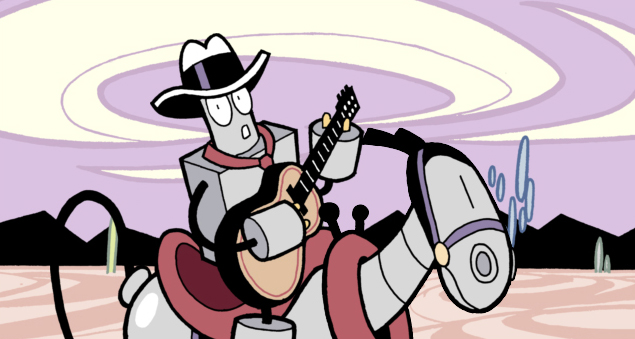
So the first thing we did was a cartoon called Ramblin Man, I think, another ASIFA-East award winner, Best Independent film. It got me to Ottawa, to Annecy. And it was actually a segment from the feature that I wrote back in this feature dream I had, which I’ve still not realized. It’s about a robot who worked for a traveling carnival and it was a musician, based on the concept of the automaton.
It took us a year to do a three minute cartoon. I think it was 2001 when I started using a Wacom tablet, and I learned about a program called Flash. Everyone that I idolized thought I was out of my mind to use Flash. They were saying, “That’s not real animation. Animation is hand-drawn. It’s not this computer trickery. This web stuff is just a phase. It’s just a fad. It’s going away. You’re going down the wrong direction.” But I was, look, the bottom line is I can draw in Flash the same way I would draw on a piece of paper. So right away my style adapted to it really well, I don’t have to do it the way everyone else is doing it. I can imagine it, sketch it, board it, draw it, color it, finish it, and watch it in one night. In one fucking night. So right away I was expediting the process. So with Ramblin Man, I did a three minute cartoon in a year.
The next year I would make a three minute cartoon in a week, literally. So I started just churning out these little indie cartoons, and that’s when I made Drunky and Plugs McGinniss and all these early cartoons that I was doing that started getting seen on the web. And that’s another crucial factor was that I was also skipping the middleman. When I would put them in festivals, that would take months and months or sometimes a year to get them out. I would put them on the web and the internet and people would see them that night. And again, all these other animation peers I had were saying, Oh, if you put something on the internet, that means it’s not eligible for festivals and don’t put it on the internet, people are going to steal your work. Don’t do this. Whatever, I kind of like it because I can put it up and then people can comment on it and I can see it. So my point is, for one time I think I was in the right place at the right time, which was where I was traditionally trained. I knew how to animate. I was excited about new technology and I was embracing the internet, whereas everyone else I knew was shunning it.
So you got the studio going. And it follows its course to giving you what you want?
Well, I was getting to make animation in unique styles with an independent approach with my friends, which is what I love to do the most. And immediately that’s what I was doing. Now, look, it was hard as hell.
Especially because you were doing so much of it yourself.
Sure, I was different. I was designing, I was directing, I was animating that side of the brain. And then you had the other side, and I was paying the rent and trying to find jobs, paying people, figuring out how payroll works and all that stuff. And it was just learning it the hard way. And I love doing it so much. It was worth it. But trust me, I was terrified every day. And it took years till I could in any way calm down and not just be in a constant state of terror. These are not mutually exclusive: being in terror and having fun.
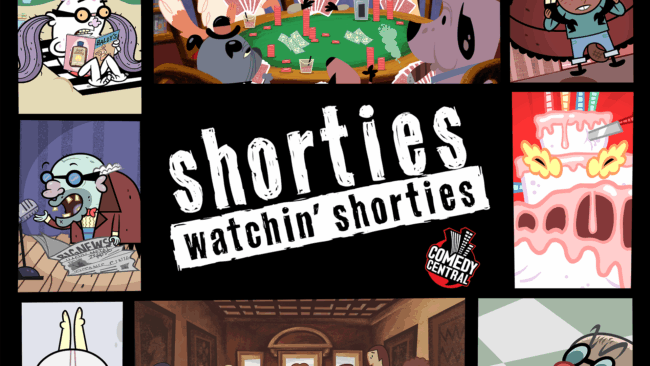
And then the first big break for me was a show called Shorties Watchin Shorties that was on Comedy Central, and that was a guy named an animator named Eric Brown who pitched the concept, give me all your old clips of stand up comedy, and I’ll animate them for cheap. How cheap can you make it? Really cheap. Okay, let’s do it. Then he got it greenlit and he came to me and, “Hey, I saw this film you made called Drunky in a festival. It looks just like what I want my cartoon to look like, and I don’t really know about animation at all.” I did a little short that he saw and he was, “Will you be the animation studio?” This is at a time when things like that could happen, right? We did ten half-hour, twenty two minute episodes in a year, never having made a show before. I think we were one of the first shows, if not the first animated show, that was on television that was made in Flash. I got a bunch of people that I knew either from MTV or other places. Peter Browngardt, now he’s directing the Warner Brothers features, Mike Wartella was somebody I knew from the underground comics world, just all these really cool people. Jeremy Jusay was somebody that I went to SVA with. I just pulled all my friends together, and we worked our asses off. We slept in the studio, made our way through making a show, and then after a year, now we’re a television studio.
And this is what year?
Around 2002. And that show got seen by the creators of this batshit crazy pilot called Wonder Showzen that was them making a nihilist version of Sesame Street, which through a crazy twist of events, got picked up on MTV because they were trying a new channel called MTV2 that they were starting to do the more avant garde things.
So I grew up with things like Liquid Television and Beavis and Butt-Head and Ren and Stimpy, and a lot of the things Linda Simensky was doing, all this really outsider cartooning that was happening in the networks. The fact that I grew up with that and was entering my career with that aesthetic, there was something in the air with these shows like Wonder Showzen, Space Ghost, Aqua Teen, Harvey Birdman, Moral Orel, these really avant garde, bizarre things happening all at once. And we were a part of that.
Always has a 2D right approach. When they said 2D was dead,
Everyone was, what are you going to do when you have to stop making 2D? And I was, Oh, let’s keep going with this forever.So we did Wonder Showzen and that became things like Adult Swim and Superjail!
But it’s so wonderful the feeling you get when you’ve pulled it off.
When you pull it off, it’s real magic. So when you’re watching a cartoon, people forget that a lot of the cartoon is working subconsciously. And when you can genuinely recreate the style that you’re parodying, well, then right away your brain goes, Oh, I know this world. You see, Ambiguously Gay Duo comes on and my brain, as a kid that grew up watching terribly animated Hanna-Barbera superhero cartoons, it clicks, okay, I’m in this world now. Now, what’s this about? It’s actually subversive because I feel the comfortability I have with this cartoon that I had with the Fantastic Four, but they’re doing these really dirty jokes and they’re doing phallic imagery, and they’re doing all this gender bending and all this really avant garde stuff. So your guard is down and you’re just the perfect audience to be shocked and laugh your ass off.
So you got the studio going. And it follows its course to giving you what you want?
Well, I was getting to make animation in unique styles with an independent approach with my friends, which is what I love to do the most. And immediately that’s what I was doing. Now, look, it was hard as hell.
Especially because you were doing so much of it yourself.
Sure, I was different. I was designing, I was directing, I was animating that side of the brain. And then you had the other side, and I was paying the rent and trying to find jobs, paying people, figuring out how payroll works and all that stuff. And it was just learning it the hard way. And I love doing it so much. It was worth it. But trust me, I was terrified every day. And it took years till I could in any way calm down and not just be in a constant state of terror. These are not mutually exclusive: being in terror and having fun.
And then the first big break for me was a show called Shorties Watchin Shorties that was on Comedy Central, and that was a guy named an animator named Eric Brown who pitched the concept, give me all your old clips of stand up comedy, and I’ll animate them for cheap. How cheap can you make it? Really cheap. Okay, let’s do it. Then he got it greenlit and he came to me and, “Hey, I saw this film you made called Drunky in a festival. It looks just like what I want my cartoon to look like, and I don’t really know about animation at all.” I did a little short that he saw and he was, “Will you be the animation studio?” This is at a time when things like that could happen, right? We did ten half-hour, twenty two minute episodes in a year, never having made a show before. I think we were one of the first shows, if not the first animated show, that was on television that was made in Flash. I got a bunch of people that I knew either from MTV or other places. Peter Browngardt, now he’s directing the Warner Brothers features, Mike Wartella was somebody I knew from the underground comics world, just all these really cool people. Jeremy Jusay was somebody that I went to SVA with. I just pulled all my friends together, and we worked our asses off. We slept in the studio, made our way through making a show, and then after a year, now we’re a television studio.
And this is what year?
Around 2002. And that show got seen by the creators of this batshit crazy pilot called Wonder Showzen that was them making a nihilist version of Sesame Street, which through a crazy twist of events, got picked up on MTV because they were trying a new channel called MTV2 that they were starting to do the more avant garde things.
So I grew up with things like Liquid Television and Beavis and Butt-Head and Ren and Stimpy, and a lot of the things Linda Simensky was doing, all this really outsider cartooning that was happening in the networks. The fact that I grew up with that and was entering my career with that aesthetic, there was something in the air with these shows like Wonder Showzen, Space Ghost, Aqua Teen, Harvey Birdman, Moral Orel, these really avant garde, bizarre things happening all at once. And we were a part of that.
Always has a 2D right approach. When they said 2D was dead,
Everyone was, what are you going to do when you have to stop making 2D? And I was, Oh, let’s keep going with this forever.So we did Wonder Showzen and that became things like Adult Swim and Superjail!
But it’s so wonderful the feeling you get when you’ve pulled it off.
When you pull it off, it’s real magic. So when you’re watching a cartoon, people forget that a lot of the cartoon is working subconsciously. And when you can genuinely recreate the style that you’re parodying, well, then right away your brain goes, Oh, I know this world. You see, Ambiguously Gay Duo comes on and my brain, as a kid that grew up watching terribly animated Hanna-Barbera superhero cartoons, it clicks, okay, I’m in this world now. Now, what’s this about? It’s actually subversive because I feel the comfortability I have with this cartoon that I had with the Fantastic Four, but they’re doing these really dirty jokes and they’re doing phallic imagery, and they’re doing all this gender bending and all this really avant garde stuff. So your guard is down and you’re just the perfect audience to be shocked and laugh your ass off.
It’s absolutely better if you can justify a small crew by and there’s also less separating into little cliques. It’s really, really important that you keep an eye on how people are feeling about the stuff that they’re doing and how they’re doing it.
And now, look at what’s out in the air, look at what won Best Animated Feature last year. It was Flow. Flow beat Pixar. I think that is a seismic change in the industry. Flow was made, to my understanding,with around a dozen people with Blender. (a free 3D animation program) Imagine how many people worked on that last Pixar movie. I think it was Inside Out 2.. There must be thousands of people. I mean, the amount of overhead in any given Pixar movie versus some guy in another country that had this unique vision for this abstract animal story, which is poetic and representative of all kinds of existential ideas. And he made that with just a handful of people virtually in Blender, a program anyone can use.
And I hope it’s the future! For example, a movie just came out called “Boys Go to Jupiter” starring Julio Torres. He’s one of the most brilliant comedians in the world today. He’s also on my show City Island. The movie was written, directed, and animated by Julian Glander, who lives in Brooklyn. At the premiere, they asked hom how he was able to animate a whole movie by himself in a year. He said, “I didn’t animate any walk cycles. Every time someone moves, they’re either a skateboard or a scooter.” That’s the kind of ingenuity that you and I love, you know what I mean? It’s like, that’s the kind of stuff.
That’d be a great future for animation.
So if somebody wants to reach out to you, what’s the process?
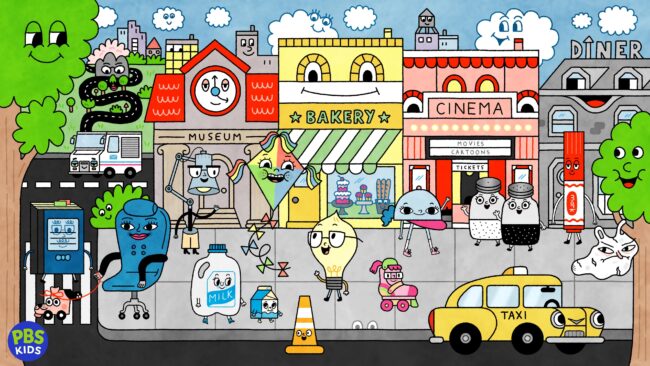
So right now our studio is fully virtual, still making lots of great projects. We’re also able to develop a lot more independent productions. Now we’re working on a feature film. We’re still working on our show City Island for PBS kids. We just got a book deal with Harpercollins for a City Island book series, which is really, really exciting. We just put out two video games this year for City Island, which is another new adventure for us, which is trying to adapt the vision that I have for animation into video games, 2D hand-drawn cartoons and video games, which has been a lot of fun. The past five years has been largely focused on educational animation.
And PBS comes with qualifications that you have to fit. You’re fine working within that?
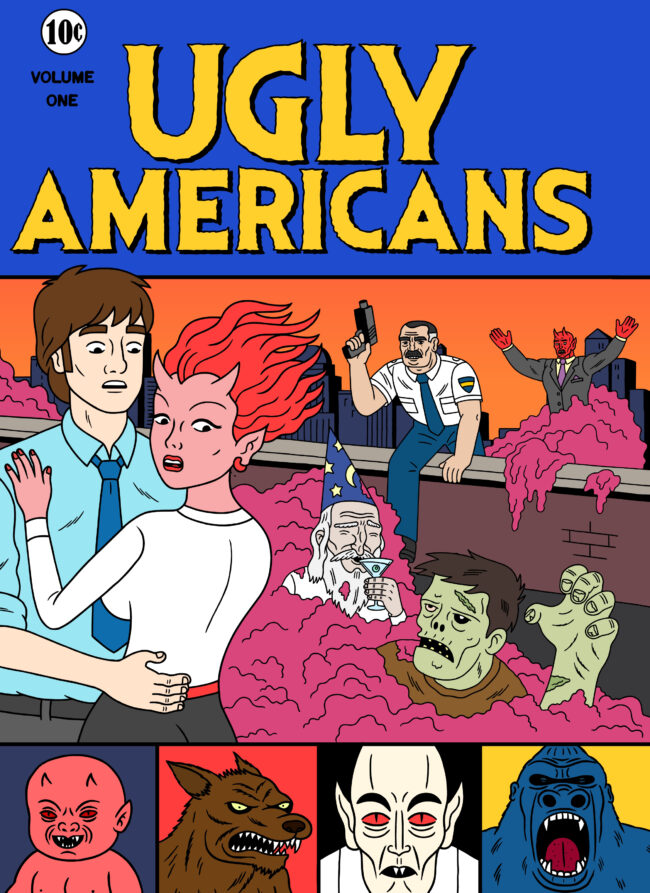
Oh, I love it. It’s been one of the most rewarding experiences of my entire life. I just had my 20th anniversary and I was like, okay, what have I not done yet? Because I get bored easily. And one funny thing is that I’ve been parodying kids animation my entire career, He-Man, Looney Tunes and Rocky and Bullwinkle my whole life. But I’ve never really made one and that would be interesting. I talked to one of my best friends, Dan Powell, who was the showrunner of Ugly Americans and he said the same thing, “I have two kids now and I want to be able to make kids cartoons that are as funny as the adult stuff that I do for Comedy Central”. So we started a studio called Future Brain in 2019 and it was essentially an outgrowth of Augenblick Studios that only makes kids cartoons.
I said, okay, what’s the kid show you’ve never seen? And we all pitched different shows, and my pitch was that my favorite aspect of animation is anthropomorphic cartoons. One of my favorite cartoons is Roger Rabbit and Betty Boop. Anything where a trash can can start talking to you, or a window will wink, or a taxi cab pulls up and says, “Where are you going, bub?” I love that stuff. And Sesame Street, for that matter. I’ve always parodied them, but I never really made one sincerely. So I want to make a show about a living city, and I want to make a show that’s about what I love about New York, which is that it’s urban, filled with a bunch of really crazy people that somehow coexist together. And the best moments are when they come together for a positive reason. City Island is New York City on a really great day.
So if somebody wants to reach you, somebody wants to work with you on a project.
Email me through the website: www.augenblickstudios.com. It’s the easiest way. There’s a contact page and it will get to me. And I’m excited about the future. And I’m excited about doing new types of projects for sure.
Well, it sure sounds like it. You and your Type-A personality,
Apparently.